
Easy Collaborative Learning Strategies for Secondary Classrooms
Written by: Emily Opell,Lauren Poole
If you step into one of our classrooms, you are almost guaranteed to see students working together in some capacity. Whether it is a whole-class activity, partner work, or a quick collaborative task at the beginning or end of class, this has become a daily part of our instruction.
We have found collaborative learning to be one of the most effective strategies for today’s students because of all of the benefits it provides. Students develop important social and problem-solving skills and engage in more active learning experiences. Collaboration can also make challenging assignments feel more manageable. Tasks such as essays, podcasts, close readings, or annotation activities can seem overwhelming when approached individually, but breaking them into smaller pieces and allowing students to work together helps build confidence and increases engagement.
At the same time, from a teacher’s perspective, collaborative learning also allows us to maximize our time. Intentionally created projects and activities can address the same skills and standards as individual assignments with less grading time. While collaboration may sometimes appear to be a room full of students working without direct instruction as the teacher circulates and monitors, there is actually a great deal of intentional planning happening behind the scenes.
When implemented well, the activities we will discuss in this blog post help create a classroom environment where students learn from one another. The result is a more interactive, supportive, and meaningful learning experience for everyone involved.
Key Takeways:
If you are looking to integrate more collaboration into your classroom without revamping your curriculum entirely, here our key takeaways and highlights from our blog:
- Jigsaw Annotations and Analysis: Divide and conquer complex texts or new annotation strategies through collaboration. Use jigsawing to give students a focused lens and have them teach that element of the text to their peers.
- Group Essays: Don’t just divide up group projects; divide paragraphs of entire essays! Protect peers from the burden of doing all the work by assigning individual grades to body graphs, while the whole group collaborates on the introduction and conclusion.
- Peer Podcasts: Ditch the poster board for a podcast. Students can informally practice research skills to find, select, and debate evidence to support claims.
- Crafting Claims with Supporting Evidence: High-impact collaboration doesn’t have to take all 5 days of the school week. Five-minute partner activities like writing a claim, trading papers, and finding evidence for a peer’s claim build foundational skills with zero teacher grading downtime.
Jigsawing Annotations and Analysis
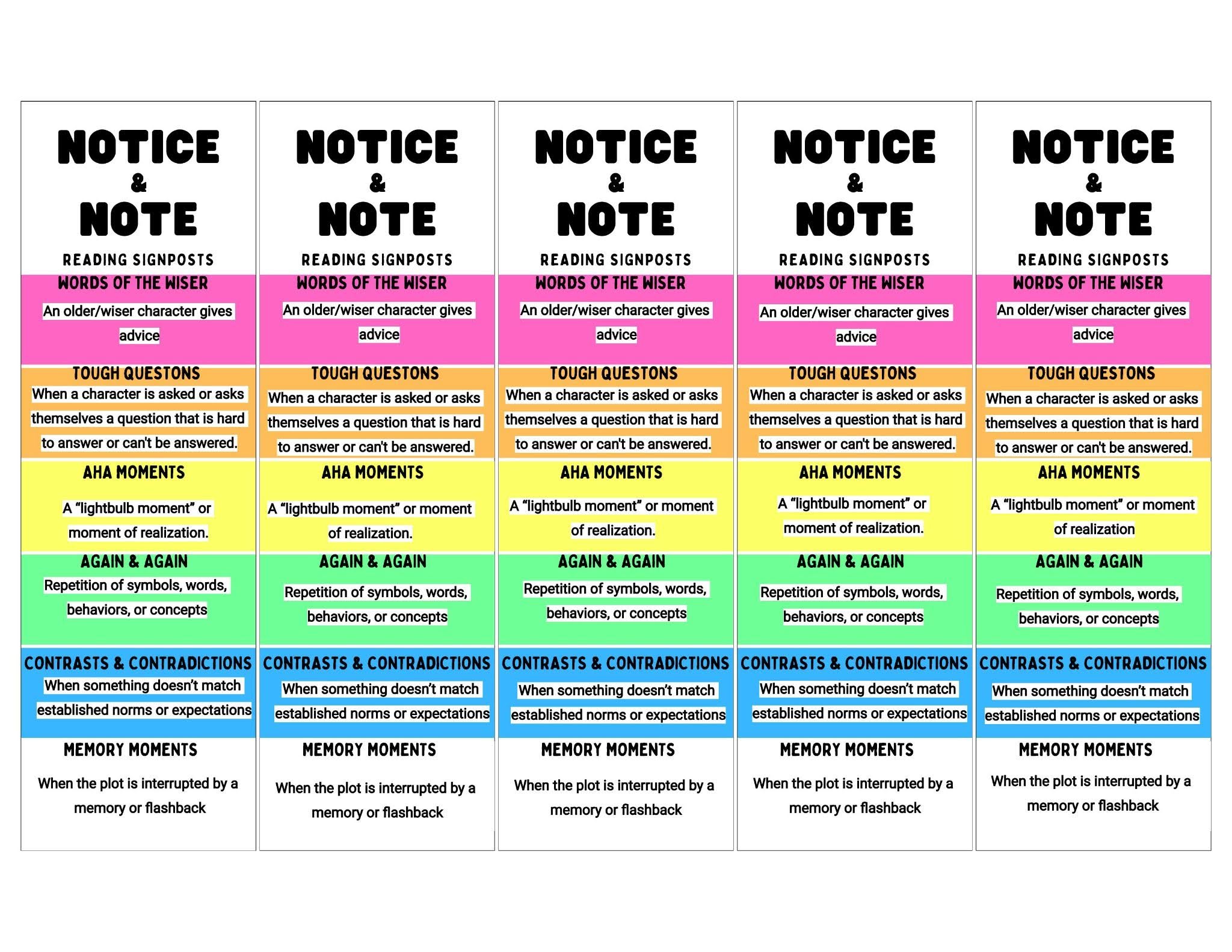
One of my absolute favorite analytical reading and annotation strategies I use with my students are the Notice and Note Reading Signposts for Fiction from literacy experts Kylene Beers and Robert Probst.
To cast a wide net of annotations throughout chapters of novels or short stories, I like to jigsaw the annotation task.
Depending on the text and where my students are in their learning, I run this jigsaw in one of two ways:
When a reading is packed with hidden meanings and endless signposts, asking students to look for everything can feel overwhelming. Instead, I assign each student just one or two specific signposts to use as their reading lens. Then, when reviewing the reading, students can first be grouped with students who had the same signposts to annotate for comparison and to validate their findings before becoming the resident expert in their assigned signposts. In a second discussion group consisting of experts in different signposts for that specific reading, they all are responsible for teaching their peers about their significant signposts findings.
Other times, when students are more comfortable finding any and all of the signposts vs just one or two at a time, I may assign them specific pages of a reading to be the signposts expert in. This smaller, more intentional focus also lends itself well to having students consider the anchor questions associated with the signposts examples for their most critical findings, practicing identifying literary devices associated with their annotations, and consider the overall impact of repetition or patterns of signposts within their selected pages.
Of course, the jigsaw method isn’t limited to the Notice and Note Signposts for fiction. You can easily apply this structure to rhetorical analysis frameworks, such as SOAPSTone or SPACECAT.
SOAPSTone + SOAPSTone Poetry Analysis
Staring down a complex historical document and trying to analyze every single element independently can be intimidating, even for our most advanced readers. Breaking down the document collaboratively lowers that anxiety barrier to learning and raises the depth of analysis for the entire group.
Instead of assigning a page range, divide your go-to analytical acronym among student groups.
If you are using SOAPSTone, assign one group to deep-dive into the Speaker, another to map out the Occasion, a third to analyze the Audience, and so on. If you are using SPACECAT, you might have one group focus entirely on Context and Exigence, while others tackle specific Rhetorical Choices.
Then, the small role groups work together to comb through the text, looking only for evidence that contributes to their assigned letter of the acronym. Once they have mastered their element, the class comes together to reassemble their pieces of the puzzle into a cohesive rhetorical analysis.
This can also be accomplished with a stations approach, which keeps the analysis moving along both literally and figuratively. I like using this approach to track tone shifts across a text. To structure the stations method, select a few excerpts of the text or document and pair them with an analytical prompt question, such as, “What is the speaker’s overall tone in these lines? What choices contribute to the tone?” I center the text pages and the question on a poster-sized sheet of craft paper.
Small groups spend around 5 minutes annotating the document and answering the prompt question on the chart paper. Both the challenge and the catch is that they cannot simply repeat a previous group’s work. They must read the previous group’s annotations, check them off if they agree, and then either challenge or question the previous analysis or build upon and expand it.
Group Essay
One of my favorite things that I’ve done for myself and my students is to streamline the process for a group essay. The second my students hear “essay,” they immediately check out, but this process makes it so much more bearable for them, and it significantly decreases my grading. Additionally, it truly helps develop deep writing skills like crafting a three-point thesis, adding transitional words/phrases, and paying more attention to the quality vs the quantity of words.
The process looks like this:
- Develop your prompt & assign your groups- 3 preferably but pairs of 2 work if the number cannot be divisible by 3. More than 3 is too big and ineffective.
- Have your groups answer the prompt by crafting a three-point thesis.
- Write the introduction as a group.
- Split the body paragraphs- each group member takes 1 thesis point.
- Add transitional words and phrases to the body paragraphs to make sure it flows well.
- Write the conclusion together.
Example: Is Odysseus a strong or weak leader & in what 3 encounters can this be seen in The Odyssey?
Student Thesis: Odysseus is a strong leader throughout The Odyssey, specifically in the times he defeats the Cyclops, visits the Underworld, and sails by the Sirens.
All group members: format paper to MLA expectations & write introduction
- Group Member 1: Craft paragraph on Odysseus vs Cyclops with the focus on leadership
- Group Member 2: Craft paragraph on leadership while visiting the Underworld
- Group Member 3: Craft paragraph on Odysseus’ leadership while passing the sirens
All group members: proofread paragraphs, insert transitions, write conclusion
As far as grading, all group members receive the same points for the formatting, introduction, cohesiveness, and conclusion. Each student receives an individual score for the body paragraph portion.
“While collaboration may sometimes appear to be a room full of students working without direct instruction as the teacher circulates and monitors, there is actually a great deal of intentional planning happening behind the scenes.”
Group Podcast
This year, I took the same exact approach as the group essay, but I put a spin on it and made a group podcast assignment. This was extremely easy to do since Google Vids is embedded as an app on our school Chromebooks.
Students followed very similar steps to the group essay, such as getting the group assignments, answering the prompt in a three-point thesis statement, dividing each point of the thesis, and then coming together for a conclusion. The only thing that was different was that they also responded to each other’s ideas more informally.
There are several benefits to this activity, but a few highlights are as follows:
- Thinking critically about what others are saying & responding appropriately
- Finding evidence to support an idea
- Introducing evidence with specific context instead of generic sentence starters
- Working with others
Crafting Claims & Finding Evidence
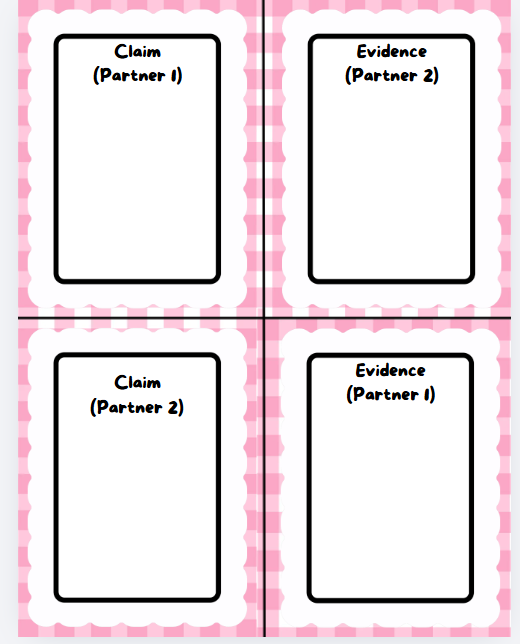
We have focused a lot on the skill of entering evidence over the last few years as a school, so we have both tried to find creative ways to do that, as well. One activity I really like for a quick hit on these skills is crafting claims and finding evidence with a partner.
The way this works is as follows:
- Students are put into pairs.
- Both students are responsible for creating a debatable claim over a reading.
- When the timer goes off, they trade claims and are responsible for finding a piece of evidence for each other’s claims.
- Often times, we will go around and share or I will cold call a few to share.
For this example, I assign it digitally and allow them to write at the same time, or I print it, cut it in half horizontally and then complete/trade/complete. Find it here.
Resources
Please login or register to claim PGPs.
Alternatively, you may use the PGP Request Form if you prefer to not register an account.