
What’s in your Classroom that Needs to Escape?
Written by: Jim Franklin
Every classroom is composed of students who exhibit a variety of strengths and weaknesses in math. In most schools and school districts, professional development is viewed as a necessity to provide teachers with the latest strategies and resources and, in many cases, increase their motivation to serve their students efficiently and effectively. Teachers participate in workshops at the district level, attend conferences, and in many states, they receive support from regional educational in-service centers. In some cases, however, even the best professional development from the best specialists and consultants is not sufficient to meet the challenges that teachers are currently facing with their students.
Presenters at professional development opportunities offer years of firsthand experience and share strategies with participants to increase students’ achievement scores, improve retention of taught skills, and meet IEP, school, and district goals and objectives for students. For some participants, when they attend professional development opportunities, they experience “information fatigue” and inadvertently overlook the presenters’ goals and expertise.
As a special education teacher for 27 years at the elementary and middle school levels, I have dealt with information fatigue, frustration, and disappointment during and after professional development opportunities. I have also taken advantage of numerous innovative ideas and strategies that I learned. It was at that time that I became thankful for those ideas that had escaped a classroom.
In September 2011, my assistant special education director asked to observe my 4th-grade math inclusion class with a math coordinator from the local regional in-service center. I welcomed the upcoming visit, but I wondered if any new strategies or interventions had been successfully implemented by other teachers with the concept of rounding whole numbers. I asked my math colleagues and searched for ideas on the internet. Honestly, there were not a whole lot of options. I only saw blocks, dry-erase markers and boards, and number lines. Other than those options, paper and pencil were the last resort. The last thing I wanted my visitors to observe were towers being built out of blocks or off-task drawings on dry-erase boards. I could not use a number line in my lesson because the longest one available only goes to 100; we were working with numbers greater than 100. Although all four options have been used for years and have had some success, I wanted math manipulatives that could make an immediate impact on educational performance and not be considered a “toy” by my students. Then, while I was walking down the hallway that I had walked down a million times, I had an idea…
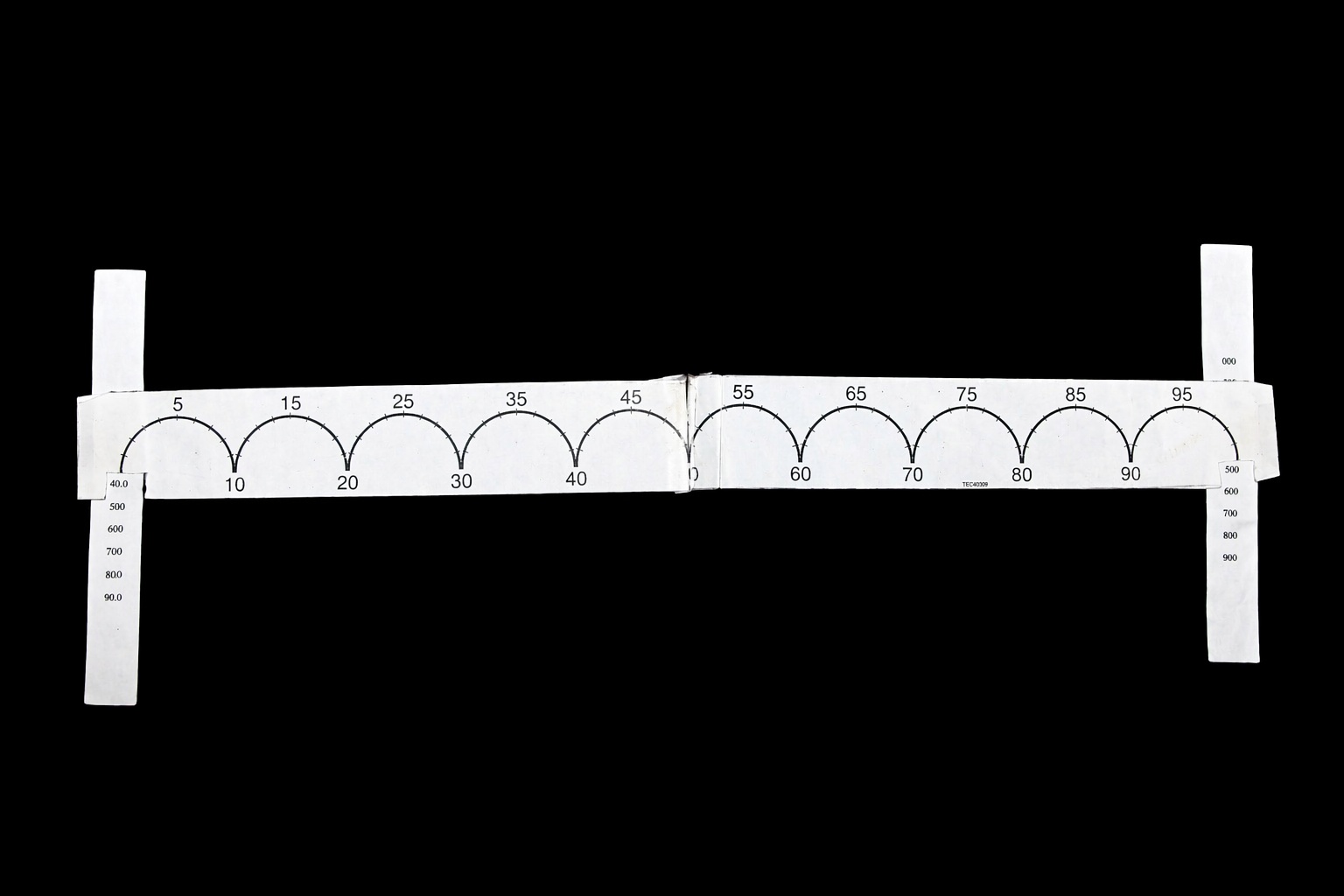
I remembered a number line that my school’s math coach had given me. It was nothing impressive because it was a copy of a horizontal number line that had semicircles on it. I frantically searched through a folder that had resources that I had collected from staff development sessions over the years. After about five minutes, I found it!
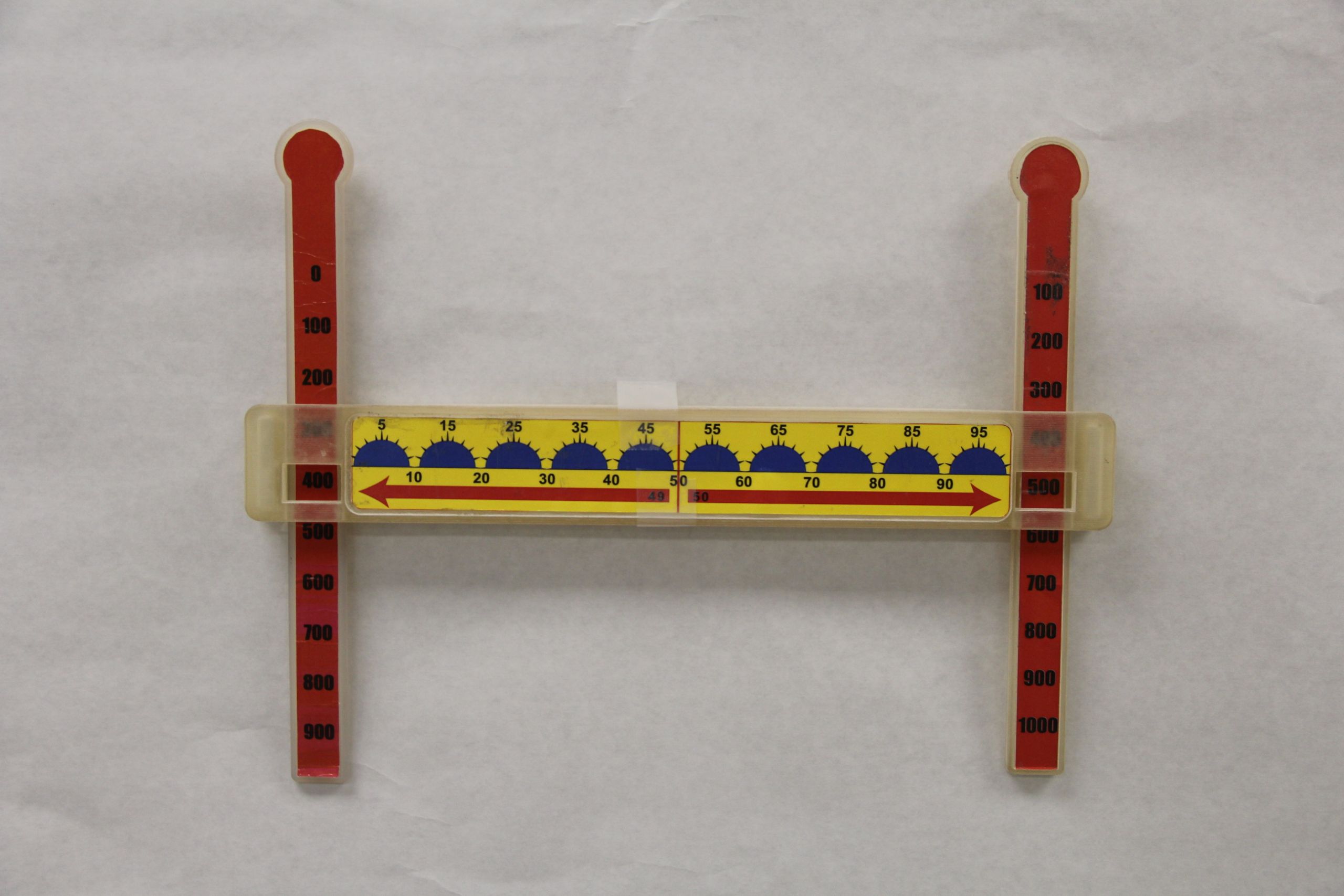
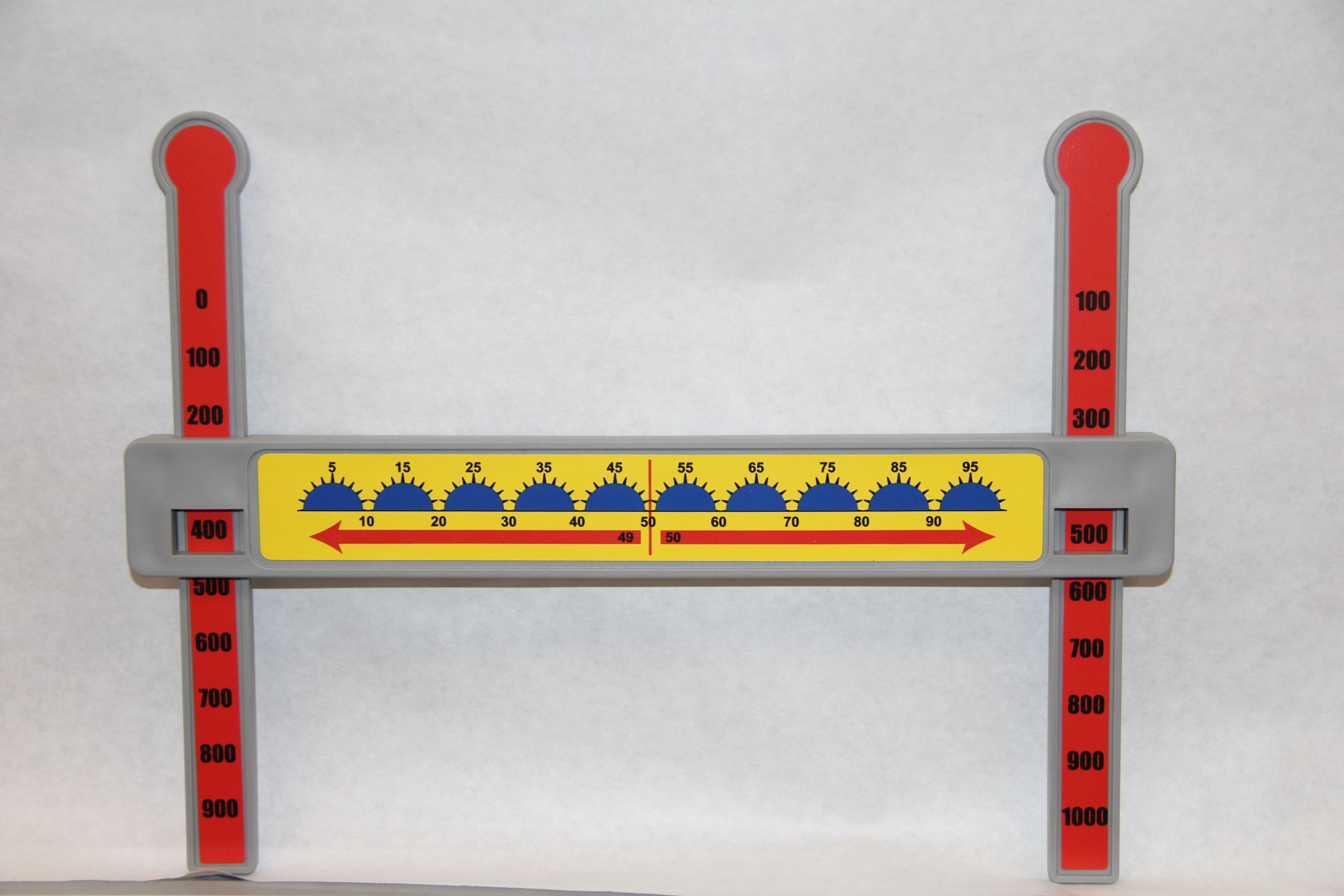
I immediately cut around the horizontal number that I found, and then I typed increments of 100s double-spaced vertically into two columns in Microsoft Word. The column on the left was 0-900. The column on the right was 100- 1,000. Then, I carefully cut out the two columns. I placed the column with 0 on top on the left side of the number line, and the other column with 100 on the right side of the number line. I thought for a minute about how the two columns need to be secured and movable. Next, I cut a small square piece of copy paper and taped it on the back of the number line. Then, I inserted the columns between the piece of paper and the number line. After my prototype was complete, I thought of a rounding math problem, such as “Round 438 to the nearest 100”, which was a problem we had done in class the previous day. I gently moved the column on the left to 400, and the column on the right to 500. I searched on the horizontal number line and found 38 with my finger. I noticed that I was closer to 400 than 500. I tried two more math problems just to make sure my thinking was correct. After both attempts and consistent reasoning through my answer, I immediately realized that my first prototype was successful.
At the end of the school day, I revisited my colleagues, trying to mask my enthusiasm, to show them my creation. Even though I was hesitant to ask them, I knew that I had to ask them the big questions: “Have you ever seen any teacher or commercially made math manipulatives like this before and do you think these could help our students?” In addition to receiving an adrenaline- rushing “No” and “Yes” response from all of them, I received very positive and optimistic feedback
I went home and shared my creation with my wife, who happens to be a high school English teacher. For a literary-minded grammarian, she seemed somewhat interested and gave me a respectful, “That looks great” response. I am not sure what I ate or what I said – if anything at all – during dinner. I flew down the stairs to my workshop and cut up a plastic “for sale” sign that we had used for a yard sale to create my second prototype. It took about an hour to measure, cut, and use a few drops of Super Glue to put it together. Then, I went back upstairs to show her the next step in the design process. At this point, my wife knew that I had an idea and that I was going to run with it.
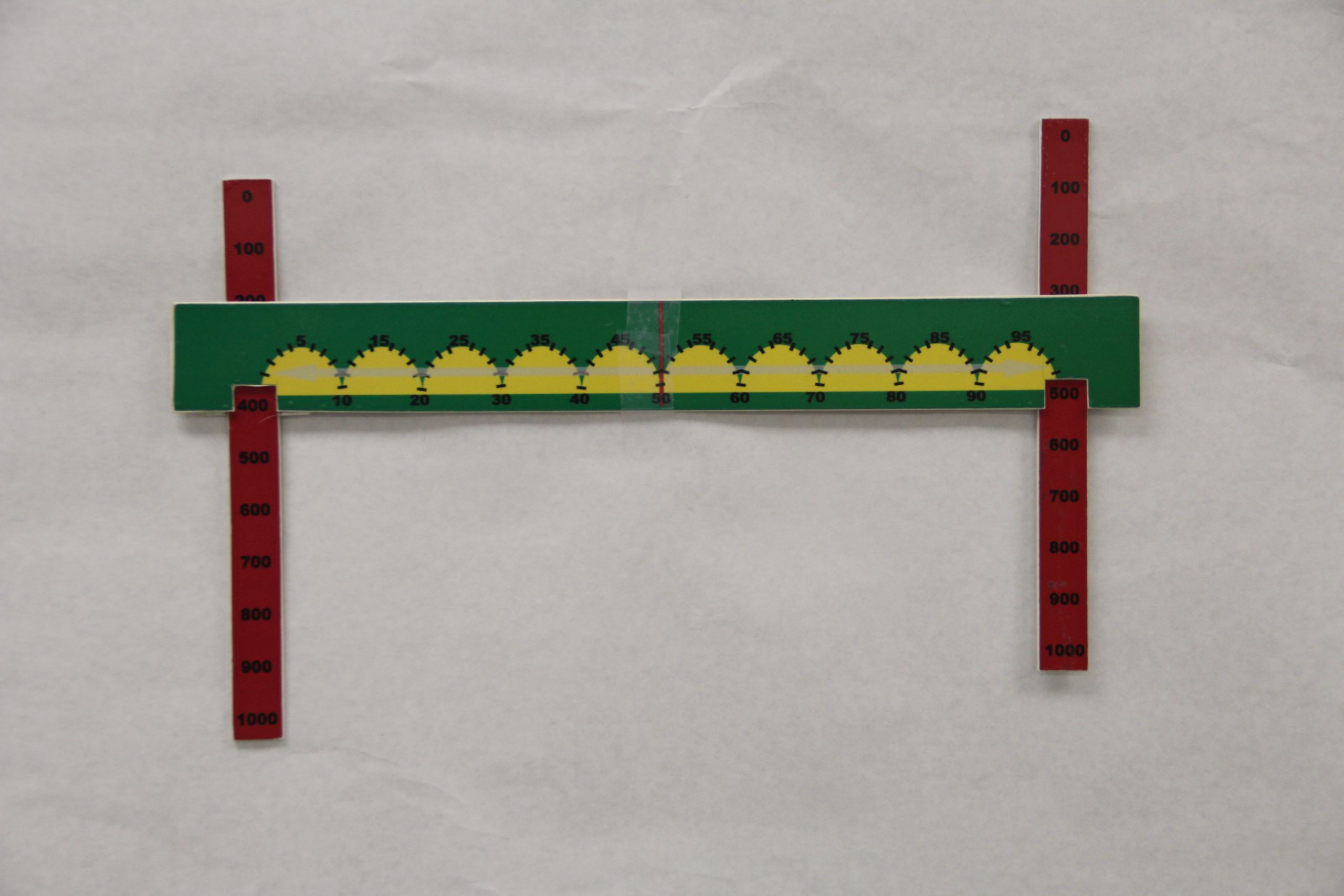
Of all of the stakeholders with whom I worked throughout the initial part of the developmental process, I most valued the student input I received. After all, they would be the ones to use these manipulatives as an essential part of their classroom instruction.
For example, the line in the middle was a suggestion from one of my Specific Learning Disability (SLD) students, Haley. After she offered her suggestion, I stated, “Haley, if you think that the line in the middle would help you, it will probably help other students. Consider it done!” On my way home that day, I replayed part of our conversation, “Which way to go….Which way to go…”, in my mind while waiting for the green arrow to appear to allow me to turn left on Kingston Road. It was at that moment that I made the connection of adding the horizontal arrows on my number line as a means for students to round numbers.
Drawing a number line can be a daunting and challenging task for students. Students frequently struggle to draw a number line that is complete and accurate, such as putting the appropriate numbers at the beginning and end of the number line. Other students lack the ability to put the numbers in the appropriate position on the number line, such as too far to the left or right and not in the middle.
One of the greatest obstacles for students is the ability to copy teacher-drawn number lines from the large dry- erase boards in classrooms to their paper and listen to their teachers’ lessons simultaneously. As a result, some students become frustrated. Because the lesson is continuing, they eventually fall behind and become more frustrated. I have worked with some students who give up and begin to exhibit behavior problems and off-task behaviors in the class. As a result, the learning environment is disrupted and compromised.
Even though the strategy of drawing a number line is a fairly common strategy for most students, low-vision and blind students require assistive technology. Other students who exhibit fine motor deficits also have difficulty drawing number lines and force teachers to make a difficult decision: should the students allocate a tremendous amount of time and energy trying to draw a number line or use assistive technology to master their rounding math standards?
Visual aids are necessary in all phases of instruction. In most cases, schools have multi-level classrooms. There are also situations when there are very high and/or low-functioning students in classrooms. In a typical fourth-grade classroom, for example, the class is expected to master the standard of rounding whole numbers to the nearest 100,000. However, there are some students who cannot round to the nearest 100,000 because they have not mastered the standards of rounding to the nearest 10,000, 1,000, 100, or 10.
In addition to having below-grade-level and grade-level students in a fourth-grade classroom, there are gifted students who have already mastered the current standard and are at the point of rounding whole numbers to the nearest 1,000,000. In some instances, gifted students are required to “go through the motions” because their peers are currently working on the rounding standards below their ability level. Teachers are responsible for meeting the needs of all their students and face increasing pressure to have students exceed district, state, and federal assessment standards. As a result, differentiation of instruction must be implemented so that all students are challenged and can build a strong math foundation.
The Next Step
In September 2011, the first student to use my second prototype was Michael, a fourth-grade student with a diagnosis of EBD (Emotional Behavior Disorder.) He was very withdrawn and had an extremely low tolerance for frustration. He also exhibited difficulty using appropriate communication skills, especially when he was upset or frustrated. Academically, he was one to two years below grade level in math calculation and math reasoning. As a result, he received special education services in a fourth-grade math inclusion classroom. Despite his behavior and academic challenges, Michael usually wanted to please his teachers. There were incidents, however, when this respectable characteristic impeded his academic progress.
I explained to Michael what his task for the day was to round to the nearest 10,000 and 1. As usual, Michael got to work immediately. However, after four or five problems, I began to see “THE LOOK” on his face. His head drooped, and his brown eyes started to water. He refused to respond or ask me any questions. I offered him much needed words of encouragement to boost his self-confidence while I watched him struggle to remember the strategies that he had been taught last year by his third-grade teacher.
After about 15 minutes, he FINALLY reached the last frustrating problem. It was a painful experience, even for me. Even though my premature creation was not the highest quality manipulative in the world, I knew that I had a means to end the agony hidden in a blue folder sitting on the creaky wooden chair beside me; I had to just patiently sit there and hope that he would remember what his third-grade teacher had taught him.
When he began to draw a random shape on his paper, I asked Michael if he was finished. He nodded, with his eyes staring at the tile floor beside his chair. Despite his academic and behavioral challenges, he was well aware that he did not have a passing grade. At this point, I screamed inside my head, “Jim, you really did it this time…. Michael’s day is going to be ruined over a review assignment that was not even going to count. You had better do something ASAP!”
I desperately tapped on the wooden table with my left index finger to get his attention. “Michael,” I whispered, bowing my head down so that I would be at his eye level, “If you listen and watch me for five minutes tomorrow, I’ll give you something to help you with these math problems. We’ll redo this assignment, and it will not count- only if you are willing to give me your best. Are you willing to do that?”
He gave me a predictable sniffling “yes” and then gave me a sigh of relief.
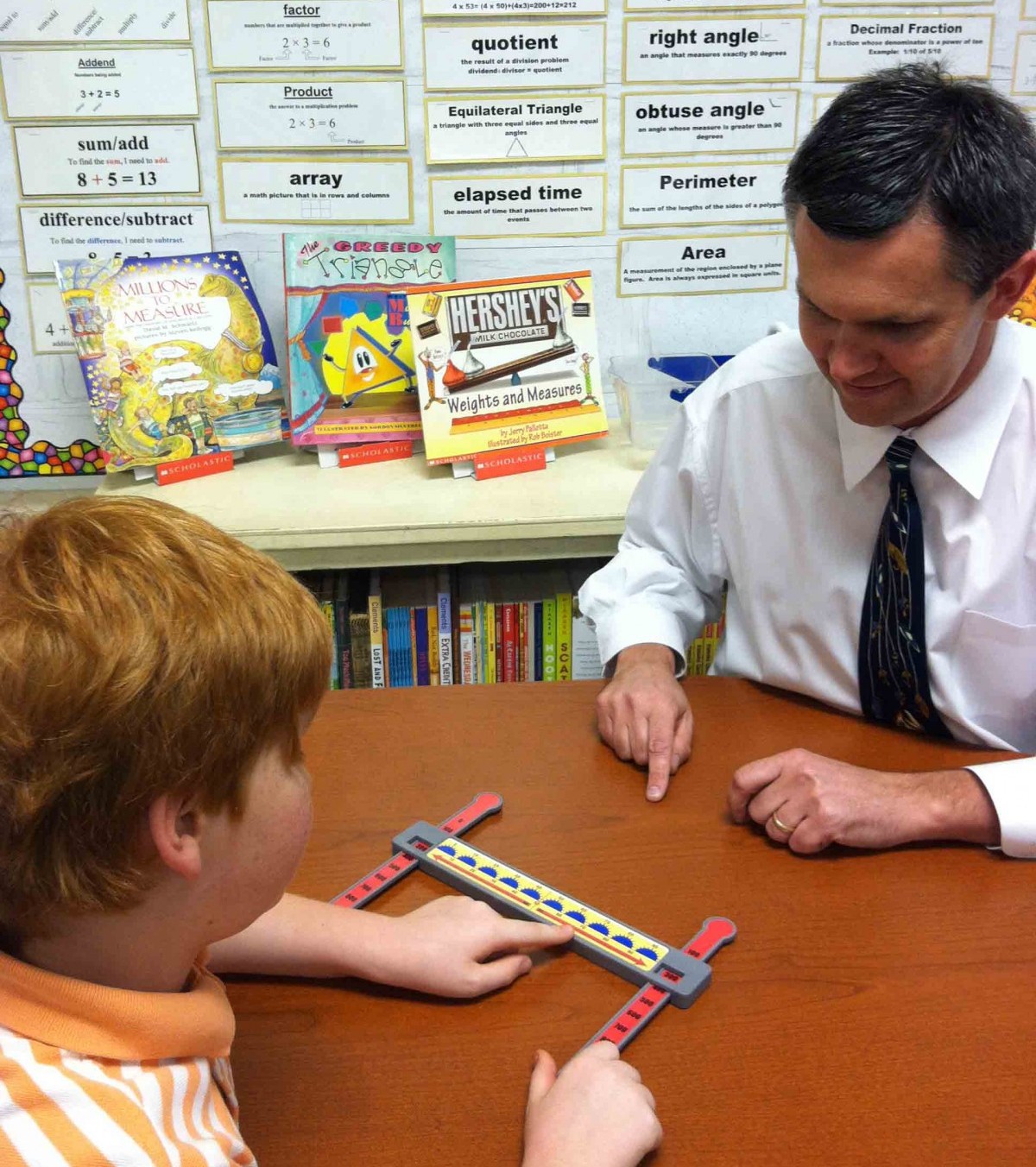
At the beginning of the fourth period the following day, we went to the same table. Then, I demonstrated my second prototype manipulative to him with the two following problems: Round 723 to the nearest 10 and 389 to the nearest 100. Michael confidently began to work after he informed me that he understood how to use what he called, “The H thing.” This time, when he was finished, he handed me his paper with a huge grin and proudly stated, “I think I did better, Mr. Franklin.”
He watched every move my red pen made while I corrected his paper. Reluctantly, he asked, “Well … How did I do?”
I quietly wrote an “80” and circled it. When I looked up at him, I saw the most self-confident grin that I had ever seen from him. He gave me the world’s accomplished grin after I showed him the “40” on his assignment from the previous day. Even though I already knew the answer, I asked, “Do you want to show Mrs. Phillips (his regular education math teacher), or do you want me to show her?”
“I do!” he exclaimed and dashed up the hallway. Fortunately, he successfully made it to her classroom door (this time) without getting caught. The “I did it” expression on his face was priceless and one that I will never forget.
At that moment, which seems like yesterday, I knew I had a special idea with the potential to help many students just like Michael, not only at Elm Street Elementary in Rome, Georgia, where I taught, but in other parts of the United States and Canada.
Worth It In The End
It was a roller coaster ride to get to this point. Susan and I have experienced many more lows than emotional highs. From September 2011 to May 2012, we did not get paid one penny while working many late nights, weekends, and during the countless “what if” and “ what do you think” sleepless nights, and meeting our financial obligations.
Teachers know their students best. Most importantly, they can see what works and what is lacking. If you are one of the many innovative teachers who have discussed ideas with your colleagues, family, and friends, my five pieces of advice to consider before you begin your journey are as follows:
- Surround yourself with positive and supportive people because many unexpected and predetermined setbacks are going to occur.
- Determine your goal, regardless of its degree of difficulty, and be committed to it.
- Self-assess your strengths and weaknesses and then find people whom you trust to “fill in the gaps.”
- Be willing to make financial and personal sacrifices.
- Accept the fact that you are going to have to work before and after your “day job” because nearly all things that are worthwhile require hard work and effort.
As I shared the beginning of my journey that began on September 11, 2012, I never thought that my first paper prototype would lead to face-to-face and virtual demonstrations in 43 states and sessions at 33 state, regional, and national conferences. My manipulatives and strategies are currently being used by students in 43 different states and Canada, despite competing with Engage New York and other math programs from multi-million dollar companies, economic uncertainty, the push for all students to have access to technology in classrooms, and working full-time as a special education teacher.
I often wonder what Michael, who is probably in his early 20’s now, is doing because I have not seen him in about six years. I will always respect him for his determination and willingness to try something new to improve his math grade. Most importantly, however, it was his smile and sprint down the hallway that instantly motivated me to take a huge risk that led to helping many students. Unless our paths accidentally cross one day, he will never know how many people his decision that September day has already and will continue to impact, which is unfortunate.
In January 2021, I saw Haley at the end of the frozen food aisle at Walmart. She still looked about the same with her long curly auburn colored hair, but she definitely hit a growth spurt since I had last seen her. It was exciting to hear that she is on a good path because it had been so many years. At the end of our conversation, she asked me, “Whatever happened to those math things you were making?” I responded with a grin, “Remember the line that you suggested for me to put in the middle. It is still there and will always be there.” Haley, who was always more of a listener than a talker, just smiled.
As I talk with many teachers, administrators, and parents at schools, education service centers, and conferences, I hear stories and nightmares about their students at schools and school districts who are struggling in all academic subjects, especially math. If you have a creative strategy or innovative intervention that could make a difference for at least one student, it’s worth taking the risk and putting the idea out into the world. What is in your classroom that needs to escape to the teacher next door or in the classroom down at the end of the hallway and to your colleagues on the other side of your school district, or in another state?
********
For updated information regarding the progress of my teaching strategies as well as my upcoming state and national demonstrations, please visit the “Latest News” tab on www.slidearoundmath.com. If you have any questions, feel free to email me (Slide-A-Round at comcast.net).
Resources
Please login or register to claim PGPs.
Alternatively, you may use the PGP Request Form if you prefer to not register an account.