
Ditch the Passive Reading: Give Every Reader Active Purpose
Written by: Lauren Poole,Emily Opell
As an English teacher, it never fails that I pick up a text and think, “What am I going to do with this today?” Aside from the standards and larger literary elements, there are so many more decisions that go into planning for a work of literature. In today’s world where students crave engagement, teachers cannot just assign a reading assignment and expect students to complete it. Therefore, we have compiled ways to break up longer texts, check for understanding, and give students a purpose for reading.
Color Quest
Annotating and highlighting are strategies as old as time, but given a catchy name and more specific instructions, it truly helps engage students in their reading AND helps prepare them for writing. To make this successful, you do have to plan backwards: 1. What is your writing task after reading? 2. What do they need to look for while reading? 3. Once you have your answers, assign colors. If students have their own copies, colored highlighters are perfect! If they don’t, colored post-its also work great! I cut mine into little strips to save on costs/materials.
Here is an example of how I’ve used this in my room:
Written Task: What characteristics make your short story by Ray Bradbury a work of dystopian literature?
Reading Task: While reading, notice and highlight the following:
Yellow: Technology
Orange: Censorship/Surveillance
Pink: Control/Loss of Freedom
Green: Loss of Individuality/Dehumanization
*Remember, because different students have different stories, yours may not have every element.
After an activity such as this one, I always have my students discuss in groups/pairs or as a class. This is usually a note-taking or learning activity, so they are welcome to alter their highlights as they hear ideas from others. Ultimately, the more they have highlighted, the easier it will be to complete the writing assignment!
Stop & Drop
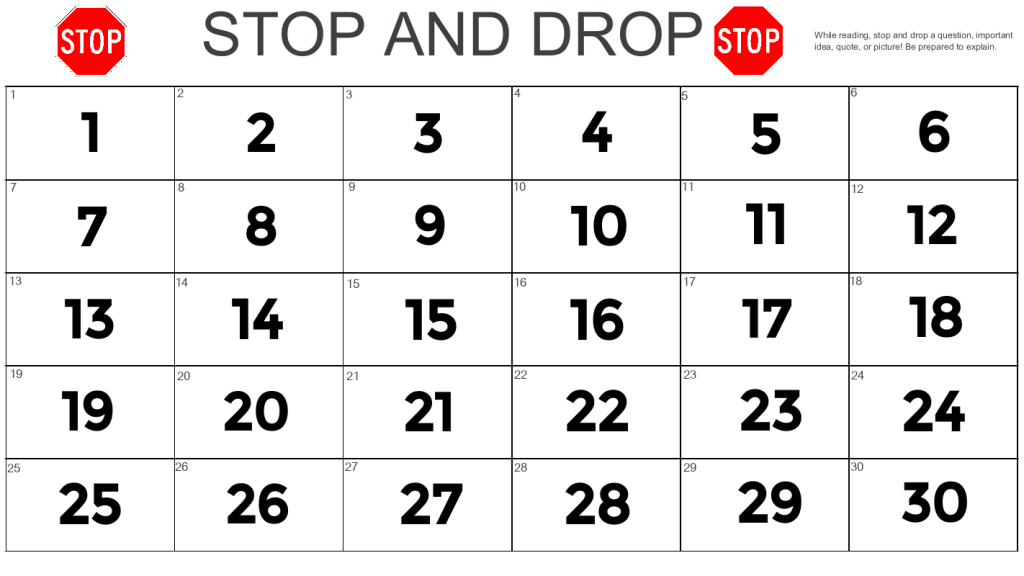
Stop & Drop is one of our favorite strategies for a quick check for understanding while reading in class. It’s exactly as it sounds – students stop reading and answer a quick question! They can do it digitally or on a post-it note that they put onto the board. You can then analyze a few student answers, sort them into categories, have students respond to them, etc.
Personally, I have moved away from a lot of digital assignments while reading because there are too many distractions, so I prefer the later choice. In my room, I have a poster board with labeled squares where students stick their sticky note answers.
No matter which version you use, be sure to give students numbers ahead of time.
Visual Reading Guides
Visual reading guides are a great way to have students identify important aspects of longer works of reading such as entire short stories or chapters of novels. When we first started doing this, we were bringing in the items and having students write down the importance of each in a variety of different activities, but then Covid hit and we had to form a digital version so we will walk you through both of these in this blog.
- Step 1: Decide on important elements that can be drawn out of a work and represented with an items or picture.
- Step 2: Design a Google Slide, Canva template, Google Document, or gather your items in person.
- Step 3: Have students write out/explain/label the importance of each item. They can do this in so many ways – on the document you created, as a gallery walk with a sheet or butcher paper & markers or post its, divided up into groups, etc. That is where your creativity comes in!
This works great for a reading check or pop quiz, too!
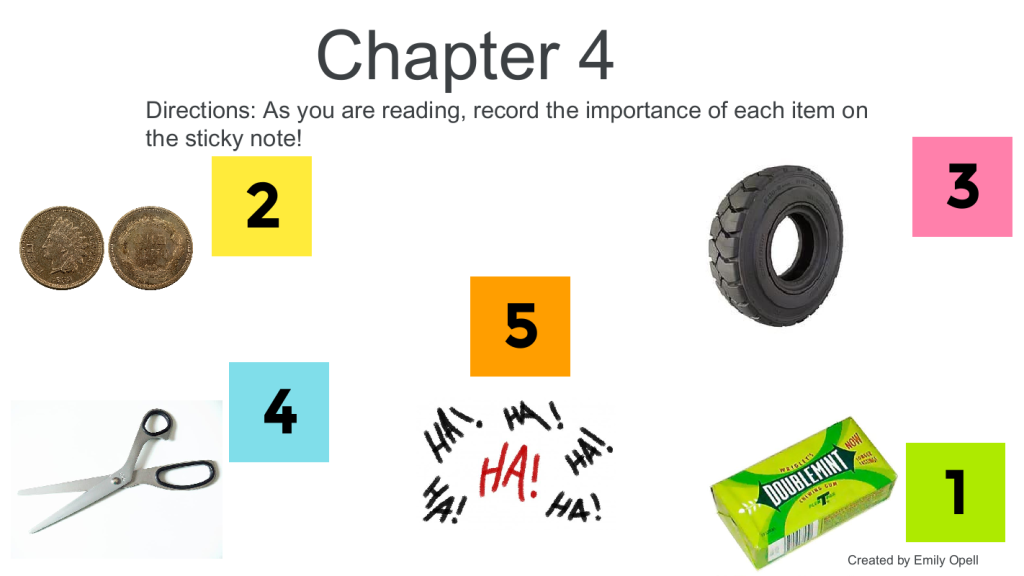
The example below is for chapter 4 of To Kill A Mockingbird.
This one is actually a modified version for struggling readers. In this version, the numbers indicate the order of events in the reading, but for my more advanced readers, I take the numbering off. However, no matter which version is assigned, students should be able to draw out important pieces of the chapter by explaining the significance of each item to both the chapter and book as a whole.
After students complete the work, I often like to group them and have them focus in on the importance or significance of one item to explain to the class. All students can add to their papers as groups explain as a form of note taking, as well.
Quote, Decode, Connect
For this strategy, we really want students to dive into important text quotations while also explaining WHY these quotes are important. This bookmark attached walks students through this & can be paired with any reason assignment!
Quote: What does the author say?
Decode: What does this mean in your own words?
Connect: Why is this important to the overall text? What does it reveal? (A theme? Character development? Symbolism? Mood? Etc.)
QuoteTA – Quotes worth Talking About
When a student is handed or digitally assigned comprehension questions that go along with reading, the temptation to “borrow” answers from a peer or via a Google search is often more appealing than completing the actual reading and answering the questions.
If students can complete their reading-related activity without doing any actual reading, unfortunately, many choose the path of least resistance.
QuoteTA is something students complete while actively reading vs after, which is looking for quotes worth talking about. Think of this like a double-sided reading journal, but in conversational form. This works for both fiction and non-fiction texts. As students read, give them a designated number, a quota of quotes worth talking about to flag with book marks, copy down, or submit digitally within a certain time frame or page range.
So, you may give your students 20-25 minutes to read a chapter or portion of a chapter with a goal of marking 3 QuoteTAs. To keep all students on the same time frame, it may be beneficial to have everyone read along in their books to an audio version as they meet their quote “quota”.
Then, the next part comes organically, which is either a whole group or small group discussion of their choices. Students’ greater understanding of the text can be assessed through these conversations either formally or informally, and they can’t simply let a classmate’s paper or Chat speak for them.
We find it helpful to display or provide discussion starter questions on the board or provide paper copies.
This student reference guide has some discussion starter suggestions, but hopefully, these will become training wheels that you can remove as students grow more confident in their choice!
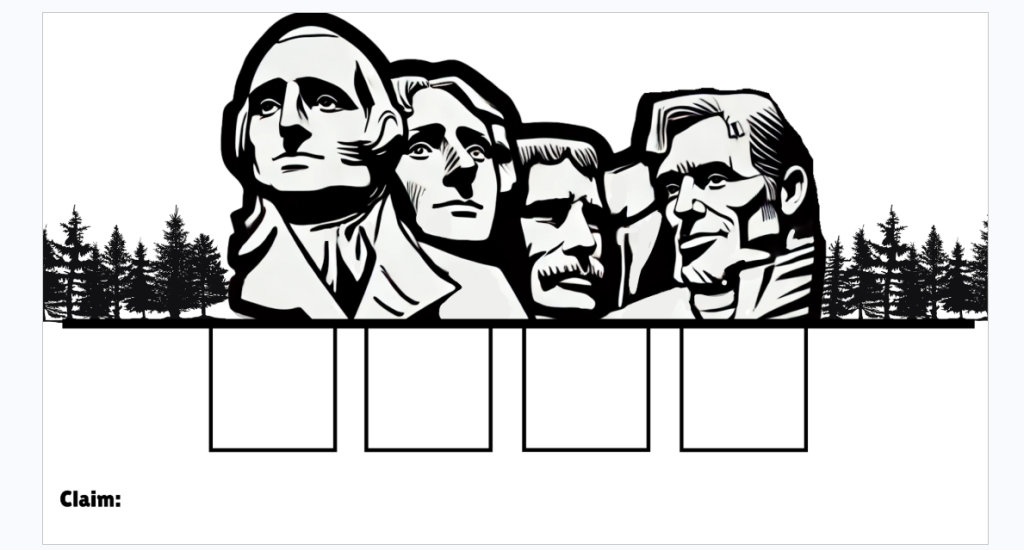
Mount Rushmore
This is a wonderful way to work on identifying the strongest and most relevant quotations from a text to support a claim. It can be used as an individual assignment or a group assignment.
Some ways to incorporate this into your classroom may look like this:
- Assigning a reading and a claim that arises from the chapter and asking students to find their own supporting evidence to fill the boxes.
- Assigning a reading and a claim and having students find their own evidence, meet in groups, and then fill the boxes with the strongest quotes the group was able to find.
- Assigning a reading and a claim and giving students quotes to then sort and fill in with the strongest ones.
Overall, when looking at a text and asking yourself what to do with the excerpt, chapter, story, etc., we hope these activities will help you and your students conquer both comprehension and in-depth analysis in a fun and engaging way.
Resources
Please login or register to claim PGPs.
Alternatively, you may use the PGP Request Form if you prefer to not register an account.