
Building Student Readiness Through Community Partnerships
Written by: Dr. Kimberly Fifer-Vissotski
Across Indiana, schools and communities are working to prepare students for a future that demands more than academic knowledge alone. Employers consistently emphasize the need for graduates who can communicate effectively, collaborate with others, demonstrate initiative, and adapt to changing workplace expectations.
Indiana’s redesigned diploma recognizes this shift through diploma seals tied to employability skills and work-based learning experiences. Yet one major question remains:
How do schools create authentic, scalable systems that ensure all students, not just a select few, develop these skills before graduation?
The answer may lie in a growing framework known as Partners for Professions, a regional model designed by CIESC to systematically organize school-community partnerships through centralized intermediary structures.
One county currently piloting this work is Hendricks County, Indiana, through its regional initiative known as WestNext.
Moving Beyond Isolated Partnerships
Traditionally, individual schools have been responsible for independently recruiting and managing industry partnerships. While many schools have built excellent relationships, the process is often fragmented, inconsistent, and difficult to scale.
Industry partners frequently report challenges such as:
- Multiple points of contact across schools
- Inconsistent expectations for student readiness
- Limited coordination of experiences
- Students arriving without foundational employability skills
The Partners for Professions framework was designed to address these exact challenges by creating a centralized partnership hub facilitated through an intermediary structure.
Rather than each district operating separately, the model organizes schools, workforce organizations, chambers, and industry partners into a coordinated system focused on talent pipeline development.
At the center of WestNext’s work is a commitment to student readiness.
“Rather than each district operating separately, the model organizes schools, workforce organizations, chambers, and industry partners into a coordinated system focused on talent pipeline development.”
Defining What “Ready” Actually Means
One of the first questions WestNext leaders asked was surprisingly simple:
What employability skills should every student consistently demonstrate before interacting with industry partners?
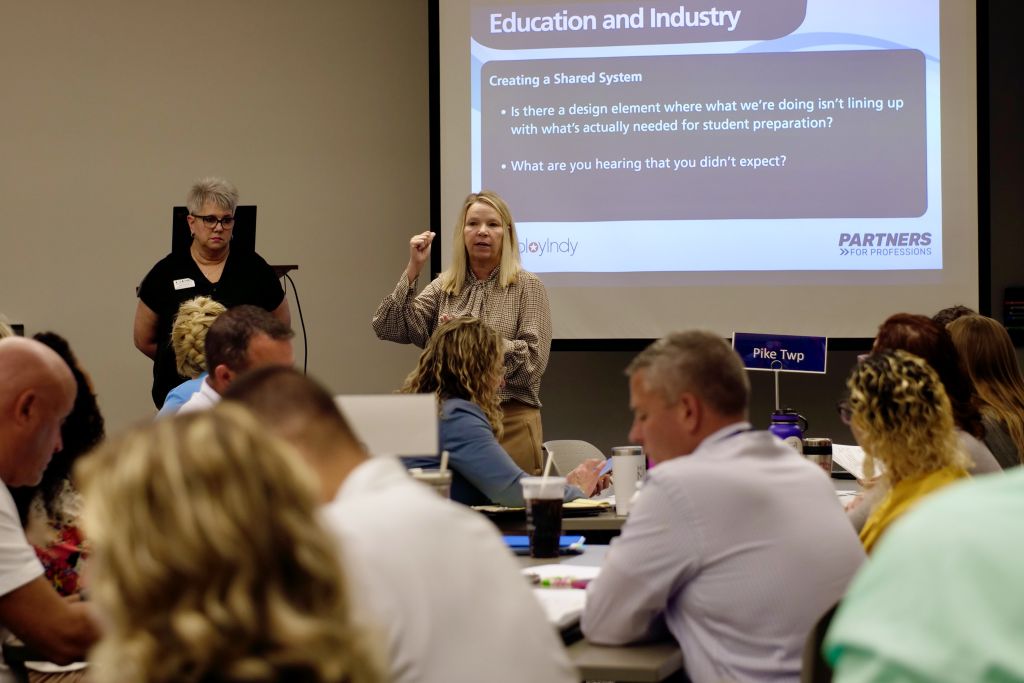
To answer that question, more than 100 industry and education partners from five Hendricks County school districts came together to examine the county’s current reality.
What they discovered was important.
Each district was using different language, different expectations, and different approaches to employability skill development. Industry partners described inconsistent student preparation, often spending valuable time onboarding students to basic workplace expectations rather than engaging them in meaningful professional experiences.
The conversation led to a shared county-wide agreement around three foundational employability skill areas:
- Communication — Clarity & Listening
- Collaboration — Teamwork & Conflict
- Work Ethic — Reliability & Initiative
What makes WestNext particularly unique is that these skills were not developed solely by educators. Industry partners helped define:
- What the skills mean
- How they should look in classrooms
- What employers expect in workplace settings
This created a shared language between schools and employers.
From Awareness to Application
The WestNext employability framework intentionally moves beyond awareness-level instruction.
For example, communication is not simply defined as speaking clearly. It includes empathic listening, navigating difficult conversations, asking clarifying questions, and using feedback as a tool for growth.
Collaboration includes teamwork, conflict management, and the ability to contribute individual strengths toward shared goals. Work ethic focuses not only on task completion, but also on ownership, initiative, accountability, and adaptability.
Importantly, each skill area includes:
- A core definition
- Classroom application examples
- Workplace expectations defined by employers
This alignment helps students understand how classroom behaviors directly connect to future success.
Creating a Seamless Continuum of Experiences
WestNext is not stopping with employability skill definitions.
The initiative is also building:
- Guaranteed Signature Experiences for all students in grades 9–12
- PK–8 career awareness experiences
- Industry-designed project-based learning experiences
- Teacher externships aligned to workforce sectors
- Coordinated expansion of high-demand pathways across the county
The goal is to create a seamless continuum of experiences that prepares students not just for graduation day, but for the Monday after graduation.
This systems-level approach reflects a larger truth: career readiness cannot depend on isolated events or individual teachers working alone. It requires coordinated infrastructure, shared ownership, and meaningful partnerships between education and workforce systems.
A Model Worth Watching
As Indiana continues implementing the redesigned diploma, initiatives like WestNext demonstrate what becomes possible when communities move beyond compliance and begin building intentional systems for student readiness.
CIESC’s Partners for Professions framework is not simply about creating more partnerships. It is about creating scalable structures that allow authentic career-connected learning to reach every student. When schools and industry partners share responsibility for preparing students, employability skills stop being abstract ideas and become lived experiences.
And when communities organize around a common vision for readiness, students gain something even more powerful than workplace skills; they gain confidence, direction, and a clearer understanding of their place in the future workforce.
Resources
Please login or register to claim PGPs.
Alternatively, you may use the PGP Request Form if you prefer to not register an account.