
Accommodations, Modifications, and SDI: What You’re Actually Responsible For
Written by: Dr. Jen Spencer
General education teachers are being asked to do more than ever before. Supporting students with diverse needs, implementing IEPs, managing behavior, and collaborating with special education staff are required duties, but often without clear training or guidance. This series is designed to close the gap between what teachers are expected to do and how prepared they feel to do it. Grounded in classroom experience, research, and practical systems, each article will challenge common misconceptions and offer clear, actionable strategies teachers can use right away. The goal is simple: to help teachers feel more confident, more effective, and more supported in inclusive classrooms.
If you have ever looked at an IEP and wondered, “What am I actually responsible for?” you are not alone. You are already handling a myriad of things with each student. This is just one more layer! There are very common questions general education teachers ask, and for good reason. The language can feel technical, the expectations can feel high, and the fear of getting it wrong is real. Some teachers are concerned that any supports interfere with academic mastery. Without clarity, it becomes easy to overextend in some areas while unintentionally missing others.
The most important way to ensure success for a student with disabilities is to build a productive relationship with the resource teacher. Check out this video from the National Center on Education Outcomes depicting a productive discussion between a resource teacher and a math teacher regarding common misperceptions on accommodations.
Each piece of the IEP is critical to the student’s success and required by law. The items have been deemed necessary by the case conference committee, and so they are non-negotiable. For more information on Indiana’s Special Education Rules, refer to Article 7. This information is not meant to create fear. Instead, this creates clarity.

“When teachers know what is expected, they can plan more effectively, collaborate with greater confidence, and respond to student needs in the moment.”
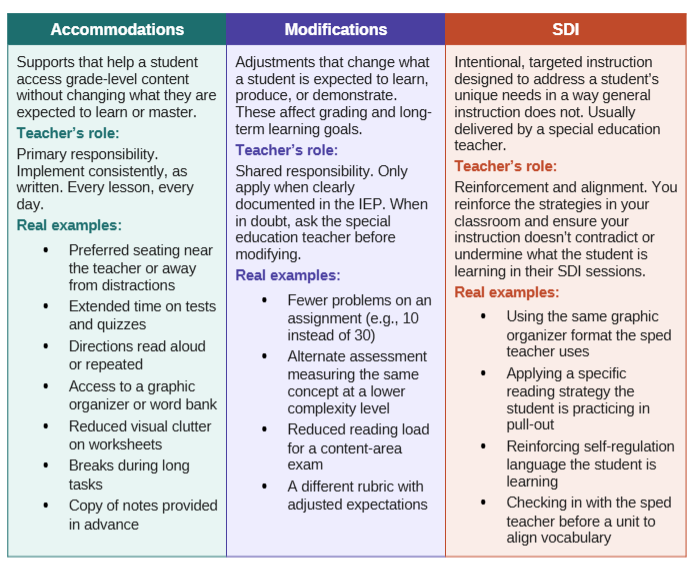
To simplify an IEP, it helps to focus on three key components: accommodations, modifications, and specially designed instruction (SDI).
Accommodations are the supports that help students access grade-level content without changing what they are expected to learn. These are typically the primary responsibility of the general education teacher to facilitate an inclusive classroom, and they are managed by the special education teacher. Accommodations should be consistently implemented as written in the IEP. Think of these as removing barriers, not lowering expectations.
Modifications, while less common, do change what a student is expected to learn. These adjustments impact the content, assessment, or outcomes and should always be clearly outlined in the IEP. Because they affect grading and long-term learning goals, it is important to understand when and how they apply.
Specially designed instruction, or SDI, is where confusion often arises. SDI is intentional, targeted instruction designed to meet a student’s unique needs. While a special education teacher often delivers it, general education teachers play an important role in reinforcing those skills and ensuring alignment within the classroom.
““If you have ever looked at an IEP and wondered, ‘What am I actually responsible for?’ you are not alone.”
Understanding these distinctions creates clarity. And clarity matters. When teachers know what is expected, they can plan more effectively, collaborate with greater confidence, and respond to student needs in the moment.
This also allows for more manageable systems. Simple approaches such as embedding accommodations into lesson plans, using quick tracking tools, or aligning with special education partners can reduce the feeling of added workload while improving consistency. These small shifts can have a significant impact on both compliance and classroom experience.
Check out the Student Supports Tracker. This is a worksheet that may be used as a quick, organized reference for supporting students with individualized needs during daily instruction. For each student, the teacher records key accommodations, modifications, and specially designed instruction directly from the IEP or 504 plan, translating formal documentation into practical, classroom-ready actions. This allows the teacher to plan lessons with those supports in mind, ensure compliance, and make real-time adjustments during instruction. The notes section can be used to track patterns, monitor progress, and record any pertinent medical information that may arise during class – such as an allergy or a tendency to have low sugar. Document what strategies are effective or need refinement. The sheet becomes a streamlined tool teachers can keep in a lesson plan binder or clipboard, making it easy to reference during planning, collaboration with special education staff, or when reflecting on student outcomes.
When expectations are clear and systems are in place, teachers are better positioned to support all learners. Students benefit from more consistent support, and classrooms become more predictable and responsive environments.
In the next installment, we will explore a common misconception: differentiation does not have to mean more work. We will explore many benefits of universal design.
Resources
Please login or register to claim PGPs.
Alternatively, you may use the PGP Request Form if you prefer to not register an account.