
Make It Make Sense: Creating Coherence so Educators and Students Thrive
Written by: Alex Podbelski
As schools across the country strive to create more coherent learning experiences for students, Greenfield Central Junior High School’s math department, whom TNTP is partnered with this year, stands out as a promising example. This fall, TNTP is collaborating with Greenfield-Central to conduct a comprehensive math diagnostic and provide strategic support aimed at improving student outcomes and building a unified instructional vision. Grounded in the research from The Opportunity Makers, our work with Greenfield Central is focused on ensuring every student, especially students with IEPs and who receive extra instructional supports, has access to strong instruction, grade-appropriate assignments, and a sense of belonging—key ingredients for coherence and academic growth. The journey at Greenfield Central illustrates how targeted, research-driven strategies and strong collaboration between teachers can help schools weave together the pieces of the student experience, so learning feels connected and purposeful throughout the day.
Imagine a fifth-grade student: During language arts they read The Phantom Tollbooth. In their intervention block they discuss cause and effect and read a book about the water cycle. After school, in their tutoring program, they practice reading 100-word passages as quickly as they can. Finally, at home, they complete an adaptive computer program where they identify the character, setting, and main idea of short passages.
What’s wrong with this depiction? As you can likely see, each component of the student’s day is separate and disconnected from the grade-level goal. No portion of their day outside of language arts class actually supports them to access The Phantom Toll Booth. Instead, the student actually has to make meaning of significantly more texts, which is not just confusing, it’s utterly exhausting.
And what does this feel like for teachers? Compounding the challenge, each of this student’s learning spaces represents an educator who is working in earnest but has no idea why their efforts are not making a difference and feels guilty for not reaching goals – which leads to frustration and burnout.
This example points to the importance of coherence: building a unified instructional program and setting priorities that are clear to all.
Research Foundation
Coherence is one the three key qualities of trajectory-changing schools TNTP identified in The Opportunity Makers, We measure coherence through the lens of students, aiming for a student experience that is predictable, logical, and unified:
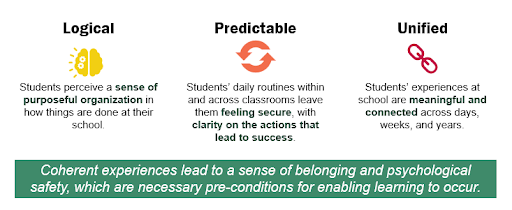
Schools build coherence in three interrelated areas:
- Coherence in Class: Students start with Tier 1 content in both classwork and interventions. The schools strongest in coherence use the same materials and curriculum for both core classes and intervention, giving students more repetition with challenging material.
- Coherence at School: Leaders clear space for teachers to focus. They continuously articulate and reinforce their focus and remove obstacles that get in the way. Everyone understands what they’re working toward and is prepared to do their part.
- Coherence at Home: Caregivers know where students stand and how to help. They know exactly where their children stand academically and how to help.
Coherent systems and system leaders weave the pieces together, so students don’t have to. Every part of their day fits together like interlocking puzzle pieces. Everything they learn in one class helps with the next. Everything they practice at home helps at school. They know what to expect and how to succeed.
High-quality instructional materials (HQIM) lay the foundation for coherent practices that benefit educators and students. For students, HQIM ensures that all students have equitable access to grade-level content and that interventions and support services build upon a solid instructional foundation. For educators, HQIM provides a common platform that fosters consistency and collaboration across learning spaces, ensuring alignment in instructional approaches and expectations.
Stories in Action
Consider the example below: How does this instructional design promote coherence?
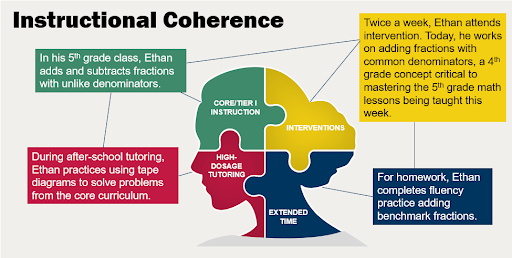
In the example above, tutoring, intervention, and extended time help Ethan practice skills he needs to master the grade level standard. In trajectory-changing schools, students say things like, “In intervention, I get to see and practice some of the things that I will need to know when I get to my regular class. And then when the teacher gives me the hard problems, I can do them.”
In coherent schools, learning experiences point to grade-level learning and make sense to students.
“Coherence has an effect on educators and students alike, with coherence being a key factor impacting staff experience and retention.”
Coherence has an effect on educators and students alike, with coherence being a key factor impacting staff experience and retention. Thus, it’s important that educators also consider the extent to which their experiences – schedules, workloads, collaboration and development opportunities, for instance – position them to create coherence for their students and advocate for shifts that would increase alignment across learning.
You can read more stories on the practices schools used to build the kind of belonging that leads to trajectory-changing experiences for students in our full research paper, The Opportunity Makers.
Tools to Use
As we learned in The Opportunity Makers, trajectory-changing schools ensure all efforts fit together. Below are suggestions for educators to support a unified instructional program and set priorities that are clear to all members of the school community, including teachers, students, and caregivers.
Consider this as a springboard, not a checklist. Educators should choose what’s relevant to their school community and adapt as needed. It’s also important to note that coherence is often built at the school level, but teachers gather data about student experience, then advocate for many of these practices. What we’ve shared below are the research-based practices often best utilized by leaders and their school teams.
1. Learn about students’ understanding of coherence
To dig deeper into trends, schools can survey students and caregivers, conduct focus groups, and spend time in class with students. Surveys allow you to collect broader input; focus groups allow you to ask more specific questions and for students to share opinions and examples. For example, surveys can tell you that students understand how the coursework connects across classes; focus groups can tell you why.
Sample survey items for students:
- I know what I need to do to be successful in my classes.
- All my teachers expect I will succeed, even on challenging assignments.
- My teachers show us how the work we are doing connects to my real life.
- The extra support I get in small groups helps me to be ready for the lessons my teacher teaches to the whole class.
Sample survey items for caregivers:
- My child’s school has let me know how to support my child’s learning at home.
- My child’s school has let me know what my child should be learning at grade level.
- My child’s teachers have let me know whether my child is performing above, at, or below grade level.
Learn more using the resources below:
2. Pick a Coherence Priority
If you haven’t yet, consider taking TNTP’s Baseline Assessment about your school’s trajectory-changing practices. You can use the assessment data and student input from the student survey to reflect on how existing school policies and practices enhance or detract from coherence. Note the strengths and gaps in individual knowledge, needs, and growth. We suggest these reflection questions:
- Individual knowledge: What shifts in practice will break down siloes of information about students across the school?
- Individual needs: How do our structures for collecting and sharing knowledge of student characteristics and academic needs reinforce collective action?
- Individual growth: How is the focus on growth over time reinforced (or reduced) with our cycle’s progress monitoring?
You can then use these reflections to select an initial school-wide focus for coherence. When in doubt, invest first in individual knowledge and build to the other areas.
Support leaders to clearly communicate the priorities for coherence to school staff, students, families, and community members and include highlighted areas of strength and growth based on the student and caregiver input and assessment of current practices.
3. Pick a Catalyzing Practice
Based on your priority and findings, choose an environment for coherence (in the classroom, at the school, and at home) and associated practice that will support progress towards your goal. These practices were found at trajectory-changing schools.
Coherence in Class
- Catalyzing Practice: Plan Tier 1 and intervention together. Create structures for teachers to plan for Tier 1 and intervention time as interconnected components rather than isolated blocks. Directly connecting Tier 1 and intervention helps students transition seamlessly between the two, building their confidence. To understand your starting state, you can ask the reflection questions in Planning for Coherence Across Learning Spaces.
- Use the same materials and curriculum. Whenever possible, draw from the same materials and curriculum in both Tier 1 and intervention. Most curriculum materials embed additional lessons, resources, and readings to support student access to grade-level content. Set the expectation that these resources are the first stop to provide additional support to students.
- Pre-teach Tier 1 content. Create opportunities for students who need extra support to preview their Tier 1 instructional concepts in smaller group settings before seeing them in class. This allows students to work through misconceptions proactively, build the necessary vocabulary, and spend additional time with grade-level materials.
- Create collaboration between Tier 1 and intervention teachers. Prioritize regular co-planning meetings for teachers across learning spaces. Allocate time and create systems that allow teachers to share lesson plans and student performance data across Tier 1 and intervention.
- For guidance on implementation, please refer to the following resources:
- Action Guide for Educators: Consistency (TNTP). See sections on consistent content and collaboration.
- Grade-Level Planning Meeting Guide, adapted from New Heights Academy Charter. See planning meeting protocols with both Tier 1 and intervention teachers present.
Coherence at School
- Catalyzing Practice 1: Set one or two school-wide priorities. Set just one or two clear, specific priorities for the school year. All members of the school community— including educators, students, and caregivers—should understand the year’s priorities and how they are expected to contribute. Choosing to elevate one or two priorities means deprioritizing many others. To clear space for sustained attention on the top priorities, develop a plan for each deprioritized area that keeps the work moving forward with fewer resources.
- Catalyzing Practice 2: Spend most of the time on those priorities. Focus areas come to life in the way leaders set and reinforce daily priorities. Most teacher and leader time should be spent working on and discussing those one or two priorities. Teachers and leaders should have narrow goals that align to the focus areas and concrete actions to take. Everyone should know exactly what is expected, how to execute it, and how they will be held accountable. This seems straightforward in theory but often falters in action, given the many competing demands of running a school. Leaders’ ability to prioritize is what often sets trajectory-changing schools apart.
- Catalyzing Practice 3: Stop initiatives and activities that do not align with school goals. To create space for teachers to focus, look for ways to do less. School leaders should actively look for ways to reduce duplicated or distracting initiatives. For example, new training might be valuable, but if it pulls time away from the core school priority, it jeopardizes coherence. While state or school improvement requirements are often non-negotiable, there may be ways that schools can meet the spirit of the requirements in a way that supports school priorities.
- See TNTP’s Goals and Priorities Audit for additional information.
Coherence at Home
- Catalyzing Practice 1: Make explicit commitments with caregivers to support student learning. Trajectory-changing schools codify shared expectations and commitments. They prioritize clear, open communication about students’ progress and challenges, ensuring caregivers are not only informed but also actively involved in their children’s education. Consider drafting a set of written expectations that educators and caregivers can agree to and revisit throughout the year. This could look like caregivers and educators signing a shared agreement on everyone’s role in student success. It could also look like standing agenda items for check-ins at caregiver-teacher conferences or other family engagement touchpoints.
- Catalyzing Practice 2: Ground caregiver interactions in student work and data. Caregivers should have an objective, accurate understanding of where their children stand and what they need to make progress. This should include transparent, easy-to-read updates on students’ academic progress, including students’ performance relative to grade-level expectations and individual growth goals. Schools should use student work and data to drive check-ins, including caregiver-teacher conferences and informal updates on student progress. One way to ensure that students’ voices are elevated is to encourage and prepare students to lead these check-ins with their families.
- Catalyzing Practice 3: Equip caregivers with simple ways to practice at home. Trajectory-changing schools draw on caregivers’ knowledge of their children, build their involvement, and make it easy for caregivers to support their children’s learning in the most meaningful ways. In caregiver/teacher conferences, schools can ask caregivers to come to the meeting with hopes for their student and solicit caregiver input on goals for the student and intervention strategies. When students are behind, educators should set a concrete action plan to help them catch up that includes accessible activities (like shared reading exercises) that caregivers can do with students at home.
- See the Caregiver Engagement Meeting Guide, adapted from Van Buskirk Elementary for additional support.
The Bigger Picture
The 1,300 schools we studied in The Opportunity Makers prove that US public schools can change the academic trajectories of millions of young people who’ve fallen behind. We’re so excited to share the promising practices these schools lean into every day, to support more educators in building the systems and environments our students all need to thrive. We’re especially excited to hear your questions and stories from the field, so please take 3 minutes or less to share your thoughts on our survey here.
Resources
Please login or register to claim PGPs.
Alternatively, you may use the PGP Request Form if you prefer to not register an account.