
Am I Doing “Dad Things” or “Teacher Things” at School?
Written by: Jim Franklin
Jim Franklin, a lifelong golfer, knows the benefits of participating in the sport. Mr. Franklin was a special education teacher at Elm Street Elementary in Rome, Georgia and wanted to plan a STEM (science, technology, engineering, and math) project to introduce golf. By overseeing his students in the ASPIRE After School Program at his school, they would design an indoor glow-in-the-dark miniature golf course; the ASPIRE program provides homework assistance for 44 students in grades 3-5 from teachers at a 10:1 ratio, includes additional instruction by using computer-based math and reading academic programs, such as MobyMax and Lexia, respectively, and writing. The students were also engaged in enrichment activities such as P.E., dance, life skills, art, music, technology, and construction.
Before Mr. Franklin requested the necessary funds and approached administrators to begin the STEM project, he wanted to survey his students to gauge their interest in designing an indoor glow-in-the-dark miniature golf course, their knowledge about golf, and experience using tools and building materials. Mr. Franklin went to the students’ classrooms with a tremendous amount of enthusiasm along with cautious optimism. He knew that building the golf course would require a substantial amount of money, time, patience, goal setting on a daily basis, and safety for everyone. As a result, it was important that all of his students were “All in.” If not, the project would not be a possibility.
“It was important that all of his students were ‘All in.’”
When Mr. Franklin showed his students a putter for the first time, none of them knew what it was called. The closest answer was “golf stick.” It is important to note that his school has an 85% minority population. Currently, the closest miniature golf course is almost an hour from Rome, which is located about an hour north of Atlanta. Because many of his students’ parents have limited transportation and income, he wanted to design a cost-effective course to give his students an opportunity to play. Due to many of his students’ limited schema and unfamiliarity with the sport, he had all of his students search on the Internet “Miniature Golf Courses” on their Chromebooks.
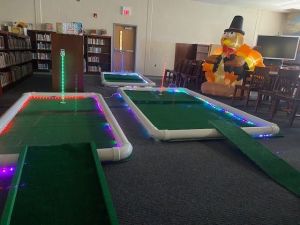
Mr. Franklin explained to his students his vision, but he stressed that he needed their help in designing the course as well as depending on their exceptional science and mathematics skills and creative technology and engineering skills to create the golf course. He emphasized that he did not have all of the ideas and valued their ideas the most, and that anything that is worthwhile requires work and effort. After all, as he explained, “The better you plan your ideas, the more advanced and better your golf course will be.” The students’ enthusiasm grew exponentially higher when they learned that they were going to build the obstacles that had a holiday theme, such as monsters during October for Halloween. Mr. Franklin also informed his students that eventually the miniature golf course would be used for tournaments, Field Day at the end of the school year, indoor recess, and “Family STEM Nights.”
Based on Mr. Franklin’s students’ reaction and the feedback that he received from them, he shared the ASPIRE After School Program’s STEM project with Ms. Laura Walley, Principal, and Dr. Leslie Dixon, Rome City Schools Director of Federal Programs and ASPIRE Program Director, the following day. He stressed that the students had to use several different math operations, develop problem-solving skills, and work together. He also stressed that this project would require several steps and teachable moments, causing the project to take several weeks to complete and that it would be an ongoing project due to the students’ designing and building holiday-themed obstacles and having lights on the holes “to bring it up a notch.”
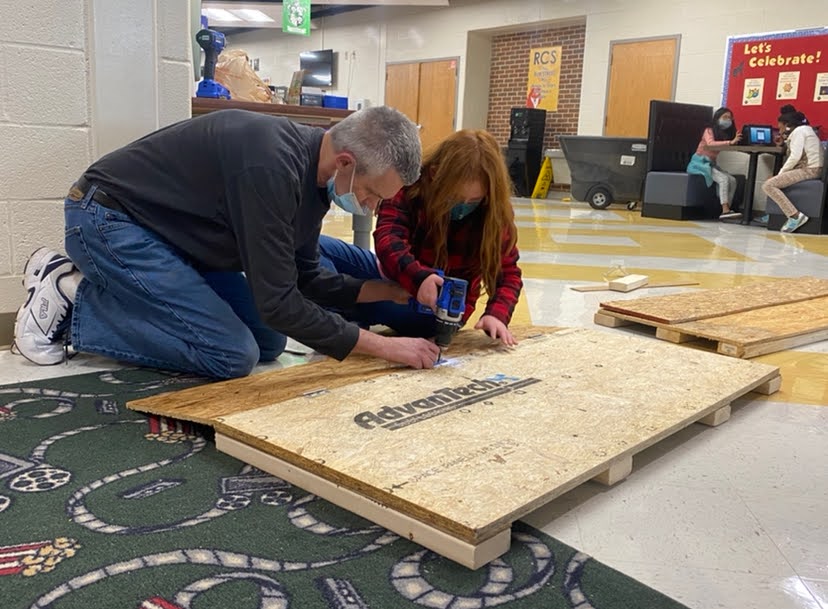
When the project was approved by his administrators, the materials were delivered to the school within a week. The students, including Mr. Franklin, were ready to begin. However, before one board was cut, one inch of turf was cut, and one screw or nail was in a piece of wood, Mr. Franklin needed to explain the rules, procedures, and expectations during the project. Then, he shared the tools that were going to be implemented and demonstrated how to use them safely. Due to safety reasons, all board cutting would be done by him. Finally, he encouraged all of the students to be team players, be open to all ideas and possibly build on them, and make the most out of the STEM project through project-based learning.
Here are the 3rd grade math standards that were addressed during the project:
Operations and Algebraic Thinking
- Represent and solve problems involving multiplication and division.
- Understand properties of multiplication and the relationship between multiplication and division.
- Multiply and divide within 100.
- Solve problems involving the four operations, and identify and explain patterns in arithmetic.
Number and Operations in Base Ten
- Use place value understanding and properties of operations to perform multi-digit arithmetic.
Number and Operations—Fractions
- Develop understanding of fractions as numbers.
Measurement and Data
- Solve problems involving measurement and estimation of intervals of time, liquid volumes, and masses of objects.
- Represent and interpret data.
- Geometric measurement: understand concepts of area and relate area to multiplication and to addition.
- Geometric measurement: recognize perimeter as an attribute of plane figures and distinguish between linear and area measures.
Geometry
- Reason with shapes and their attributes.
Mathematical Practices
- Make sense of problems and persevere in solving them.
- Reason abstractly and quantitatively.
- Construct viable arguments and critique the reasoning of others.
- Model with mathematics.
- Use appropriate tools strategically.
- Attend to precision.
- Look for and make use of structure.
- Look for and express regularity in repeated reasoning.
Here are the 4th grade math standards that were addressed during the project:
Operations and Algebraic Thinking
- Represent and solve problems involving multiplication and division.
- Understand properties of multiplication and the relationship between multiplication and division.
- Multiply and divide within 100.
- Solve problems involving the four operations, and identify and explain patterns in arithmetic.
Number and Operations in Base Ten
- Use place value understanding and properties of operations to perform multi-digit arithmetic.
Number and Operations—Fractions
- Develop understanding of fractions as numbers.
Measurement and Data
- Solve problems involving measurement and estimation of intervals of time, liquid volumes, and masses of objects.
- Represent and interpret data.
- Geometric measurement: understand concepts of area and relate area to multiplication and to addition.
- Geometric measurement: recognize perimeter as an attribute of plane figures and distinguish between linear and area measures.
Geometry
- Reason with shapes and their attributes.
Mathematical Practices
- Make sense of problems and persevere in solving them.
- Reason abstractly and quantitatively.
- Construct viable arguments and critique the reasoning of others.
- Model with mathematics.
- Use appropriate tools strategically.
- Attend to precision.
- Look for and make use of structure.
- Look for and express regularity in repeated reasoning.
Here are the 5th math standards that were addressed during the project:
Operations and Algebraic Thinking
- Write and interpret numerical expressions.
- Analyze patterns and relationships.
Number and Operations in Base Ten
- Understand the place value system.
- Perform operations with multi-digit whole numbers and with decimals to hundredths.
Number and Operations—Fractions
- Use equivalent fractions as a strategy to add and subtract fractions.
- Apply and extend previous understandings of multiplication and division to multiply and divide fractions.
Measurement and Data
- Convert like measurement units within a given measurement system.
- Represent and interpret data.
- Geometric measurement: understand concepts of volume and relate volume to multiplication and to addition.
Geometry
- Graph points on the coordinate plane to solve real-world and mathematical problems.
- Classify two-dimensional figures into categories based on their properties.
Mathematical Practices
- Make sense of problems and persevere in solving them.
- Reason abstractly and quantitatively.
- Construct viable arguments and critique the reasoning of others.
- Model with mathematics.
- Use appropriate tools strategically.
- Attend to precision.
- Look for and make use of structure.
- Look for and express regularity in repeated reasoning.
Students experienced a variety of successes during the project because they learned grade-level math standards and reviewed standards from previous grades. Due to the lingering effects of interrupted instruction during the COVID-19 pandemic, Mr. Franklin found reviewing previously taught standards very beneficial for all students.
Some students had achieved successes that are not academically related and measured or assessed during state-wide assessments, such as overcoming the fear of the noise that a drill makes while in use and then drilling a perfect hole. Other students exhibited either a sigh of relief or just confidently glanced into his eyes because they were able to successfully screw a drill into a piece of wood. Many students, including the very shy, academically challenged, and most athletic students, had a priceless smile for making a three-foot putt on the hole they had built.
Mr. Franklin spent extra time with some of the more challenging students that had no impact on the miniature golf course design or its appearance. In the platform around the golf hole, there are some roofing nails in the boards. While the students thought they were building part of the project, Mr. Franklin was building relationships. For example, the relationship building occurred when he and the student were sitting on the tile floor with a hammer and one roofing nail. First, Mr. Franklin demonstrated how to hold the hammer with one hand and how hard to hit it. He stated, “Here is the hammer. While you softly tap this nail into the board, I will hold the nail until you get it started. Then, you pound it into the wood.” The student who was working with Mr. Franklin paused for a second, looked at him, and then whispered, “What if I hit your finger?” Mr. Franklin responded, “No, you won’t. I trust you.”
There were some times of minimal pain, but a lot was gained for the students who needed it the most. Because Mr. Franklin was an inclusion special education teacher, who taught in many grade levels during the school day, he continuously tried to earn the trust and mutual respect from the students he served in the several classrooms during the school day. These two-minute incidents of hammering a nail into wood had the potential to pay enormous dividends for a day, week, month, or a lifetime.
“These two-minute incidents of hammering a nail into wood had the potential to pay enormous dividends for a day, week, month, or a lifetime.”
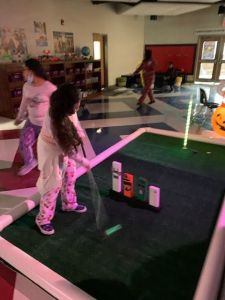
Due to ASPIRE instructional guidelines, students were expected to complete a certain amount of tasks and minutes per week on the computer-based programs. As a result, the students were allowed to build the miniature golf course approximately 1 ½ hours per week for 15 weeks. Because teaching some fractions and measurement standards were necessary to complete certain parts of the project, such as using a tape measure, not all parts and golf holes took the same amount of time and effort.
Because the students would continually design and build obstacles, the STEM project was ongoing. Mr. Franklin has had many opportunities to share his students’ amazing STEM project with his friends, colleagues, and family because of the progress that they have made in so many areas. Mr. Franklin also believes that he has achieved many of his personal goals by teaching many math standards and life skills while building relationships with his students. However, he potentially met a goal that he never thought about before, during, or after the project until recently, when he was discussing it with his daughter, Sarah Kate,a recent college graduate.
Sarah Kate made a mind-jarring comment that made it all worth having a couple of sore fingers and removing a few splinters from his fingers, wearing clothes covered in sawdust, and enduring some stress from trying to complete a highly-anticipated STEM project at his school in a timely manner.
“When you were doing the project with your kids”, stated Sarah Kate, “You were able to do some ‘Dad’ things, like what you have done with me. Not all kids have a dad. They will always remember you for that.” Franklin thought to himself, “If that feeling happened with just one student, it was worth more than the standards being taught.
For additional information about the ASPIRE glow-in-the-dark miniature golf course or any of Mr. Franklin’s other STEM projects, he can be reached at Slide-A-Round@comcast.net.
Resources
Please login or register to claim PGPs.
Alternatively, you may use the PGP Request Form if you prefer to not register an account.