
Making a Classroom Economy System Work
Written by: Amy Hughes
A classroom economy sounds great in theory. But if you’ve ever tried to run one consistently, you know the promise and reality don’t always match.
On paper, it looks like a win-win. Students learn financial literacy while building responsibility and positive behavior habits. In practice, it can quickly become one more thing on your already full plate.
Lost paper money. Time spent counting and tracking. Students are constantly asking, “How much do I have?” And a classroom store that somehow takes up your entire Friday block.
Sound familiar?
For one Texas teacher, those challenges weren’t just frustrating. They were unsustainable.
When a Great Idea Becomes Too Much to Manage
Cindy Morgan, an upper-elementary language arts teacher, had already built a strong classroom economy. Her students were motivated; they loved earning money and were excited about rewards.
But behind the scenes, the system was starting to break down.
“Before Schoolhouse Moolah, my students really struggled keeping track of their cash. The school cash was everywhere. Even with personal jars, it would get misplaced all the time.”
Managing the system took just as much effort. Cindy recalls, “I had a paper tracker for class incentives. I had to count the cash students turned in and give class updates. Many times, it was the same students contributing to the class prize.”
And then there was the classroom store: “The store took about 30 minutes to run on Fridays. Sometimes I needed two or three adults if I wanted to stay within the timeframe.”
For many teachers, this is the tipping point. A system designed to support classroom culture ends up creating more work than it solves.
Research backs this up. Classroom economy systems are powerful because they reinforce behavior and build financial literacy through experience, but they need to be simple enough to manage consistently in a real classroom.
Cindy knew the benefits of a classroom economy system were worth it. She just needed a better way to make it work.
A Tool That Fits the Classroom, Not the Other Way Around
When Cindy discovered Schoolhouse Moolah, she wasn’t looking for a complete overhaul. She was looking for a way to keep what worked and eliminate what didn’t.
“I was on the lookout for a tool that could offer my students real-life financial literacy, especially with online banking.”
Her first impression? She shares, “I was impressed with how easy it was for students to log on and start checking their accounts. They were very excited about creating their own avatars.”
But what mattered most wasn’t just ease of use. It was flexibility. Instead of forcing her to adopt a rigid system, Schoolhouse Moolah allowed Cindy to adapt it to her classroom and her unique students—90% of whom are neurodivergent.
She even turned the transition into a learning moment: “I taught my students about currency and exchange. I explained that when I visit my family in Honduras, I convert dollars into lempiras. We did the same thing, converting our classroom cash into Schoolhouse Moolah.”
In other words, the tool didn’t replace her system. It strengthened it.
What a Classroom Economy Looks Like When It Actually Works
Here’s where Cindy’s approach stands out. She didn’t just digitize her classroom economy. She made it more meaningful, more efficient, and more connected to real life.
Turning Everyday Choices into Real Decisions
In Cindy’s classroom, money isn’t just for big rewards. It’s part of daily decision-making. A few of her favorite ways to work the money into daily classroom life are: “You want to sit next to your friend? That’s a $3 daily fee. Finish your work early? You can pay $1 to free draw. Flexible seating during reading is $2.”
Students are constantly weighing choices and deciding whether to spend now or save for later. That’s where students begin to make meaningful connections.
Instead of abstract lessons, students practice budgeting and decision-making in real time. Research shows this kind of experiential learning helps students build stronger financial understanding without requiring a separate lesson block.
A Self-Checkout System That Builds Independence
One of Cindy’s most effective innovations is also one of the simplest: “I was able to get a self-checkout system started where students can check out their daily items using a tablet. They just click on their name, select their fee, and go on with their day.”
Without the manual tracking, interruptions, and bottlenecks of previous systems, Cindy was able to stick with Schoolhouse Moolah long enough to see noticeable improvements in student behavior.
“As an upper elementary teacher, my focus has always been to increase student autonomy and independence.”
This shift is key. Instead of the teacher managing every transaction, students take ownership of their choices.
Making Earnings Meaningful and Accessible
Cindy also rethought how students earn money: “I make earning accessible for all students. If it affects school accountability or student performance, I make it a way to earn. If you score 20 percent, you still get paid. I want them to feel rewarded just for trying.”
That includes:
- Attendance
- Academic effort
- Station work
- Peer tutoring
This approach removes barriers and builds motivation across the board. It also aligns with what we know about engagement. Students are more motivated when they see a clear connection between effort and reward.
Student-Driven Rewards That Actually Motivate
If you’ve ever struggled to keep a classroom store exciting, Cindy’s approach offers a simple solution. Let students help shape it.
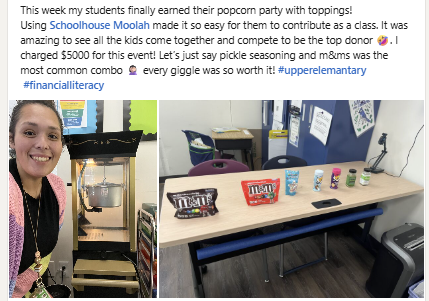
Cindy regularly gets reward ideas from students: “My students love raffles. I raffle off 3D printed toys, large chip bags, and specialty drinks. Whatever suggestions my students have, I see if I can make it work. I get the best ideas from my students. It truly is a community class effort.”
That sense of ownership makes a meaningful difference. Students aren’t just participating. They’re invested.
The Impact: More Than Just Behavior Management
So what changed once Cindy made the Schoolhouse Moolah shift? For starters, students became more intentional. She overhears students say, “‘No thanks, I’d rather read a book so I can save up for the store.’”
That’s a meaningful shift. Students are thinking ahead, prioritizing, and making smart trade-offs.
Participation in class rewards also increased: “Overall, participation in class prizes has increased. Students motivate one another until they reach their goal.”
Over time, financial literacy became part of everyday language.
“Schoolhouse Moolah makes me use words like transactions, refunds, fees, deposit, and payday. This is the vocabulary our students need exposure to.”
Perhaps most importantly, students began to take ownership of their learning and behavior: “Students are aware of how they can use their money. They compare their spending habits. It brings awareness to their earning and spending.”
A System That Works for Teachers, Too
While student impact matters, teacher sustainability is what determines whether a system lasts. For Cindy, that’s where the biggest shift happened.
“I don’t have to track anything. Schoolhouse Moolah allows me to track attendance, engagement, and what students spend their money on.”
This reduced the need for printing money, counting cash, and managing physical systems. Instead, Cindy enjoys rewarding students instantly and seamlessly. Even better, Schoolhouse Moolah supports data collection: “I’m able to track certain IEP goals using the app.” That combination of efficiency and insight is what turns a good system into a sustainable practice.
Consistency Across Classrooms
Another unexpected benefit is the built-in consistency across teachers. Cindy shares, “My partner teacher and I share pricing across the board. Students need consistency across classrooms, and this takes the guessing away.”
Other staff members have started using the system as well: “The music teacher uses it. Our kids learned how to toggle between both classes. It’s been awesome to see how comfortable they’ve become with the platform.”
When systems align across classrooms, expectations become clearer, students internalize school norms, and behavior improves. Cindy’s students are experiencing that now with Schoolhouse Moolah.
Advice for Teachers Who Want to Get Started
If you’re considering a classroom economy system or looking to improve one, Cindy’s advice is simple.
“I promise you, Schoolhouse Moolah will save you time in the long run. It’s super easy to get started.”
Her biggest recommendation is to set aside time for students to get used to the platform. Cindy offers this idea: “I took a morning meeting to help them log in and understand it. I made announcements about the transition so it felt seamless.”
You don’t need to rebuild everything. You just need a system that works with you.
The Bigger Picture
At its core, a classroom economy is not about rewards. It’s about helping students understand how their choices connect to outcomes. When done well, it builds:
- Responsibility
- Independence
- Decision-making
- Financial literacy
And it does so in a way that fits into what teachers are already doing.
As Cindy’s classroom shows, the difference is not simply having a classroom economy. It is having one that teachers can actually sustain.
When students start thinking, “I’ll save instead,” or “That’s worth it to me,” something shifts. The classroom economy becomes more than a reward system. It becomes real learning.
Curious to See How This Could Work in Your Classroom?
Schoolhouse Moolah offers a simpler way to build responsibility, strengthen classroom culture, and introduce real-world financial literacy, all without the usual complexity.
Get started for free at Schoolhouse Moolah. No overhaul required.
“Schoolhouse Moolah makes me use words like transactions, refunds, fees, deposit, and payday. This is the vocabulary our students need exposure to.”
A System That Works for Teachers, Too
While student impact matters, teacher sustainability is what determines whether a system lasts. For Cindy, that’s where the biggest shift happened.
“I don’t have to track anything. Schoolhouse Moolah allows me to track attendance, engagement, and what students spend their money on.”
This reduced the need for printing money, counting cash, and managing physical systems. Instead, Cindy enjoys rewarding students instantly and seamlessly. Even better, Schoolhouse Moolah supports data collection: “I’m able to track certain IEP goals using the app.” That combination of efficiency and insight is what turns a good system into a sustainable practice.
Consistency Across Classrooms
Another unexpected benefit is the built-in consistency across teachers. Cindy shares, “My partner teacher and I share pricing across the board. Students need consistency across classrooms, and this takes the guessing away.”
Other staff members have started using the system as well: “The music teacher uses it. Our kids learned how to toggle between both classes. It’s been awesome to see how comfortable they’ve become with the platform.”
When systems align across classrooms, expectations become clearer, students internalize school norms, and behavior improves. Cindy’s students are experiencing that now with Schoolhouse Moolah.
Advice for Teachers Who Want to Get Started
If you’re considering a classroom economy system or looking to improve one, Cindy’s advice is simple.
“I promise you, Schoolhouse Moolah will save you time in the long run. It’s super easy to get started.”
Her biggest recommendation is to set aside time for students to get used to the platform. Cindy offers this idea: “I took a morning meeting to help them log in and understand it. I made announcements about the transition so it felt seamless.”
You don’t need to rebuild everything. You just need a system that works with you.
The Bigger Picture
At its core, a classroom economy is not about rewards. It’s about helping students understand how their choices connect to outcomes. When done well, it builds:
- Responsibility
- Independence
- Decision-making
- Financial literacy
And it does so in a way that fits into what teachers are already doing.
As Cindy’s classroom shows, the difference is not simply having a classroom economy. It is having one that teachers can actually sustain.
When students start thinking, “I’ll save instead,” or “That’s worth it to me,” something shifts. The classroom economy becomes more than a reward system. It becomes real learning.
Curious to See How This Could Work in Your Classroom?
Schoolhouse Moolah offers a simpler way to build responsibility, strengthen classroom culture, and introduce real-world financial literacy, all without the usual complexity.
Get started for free at Schoolhouse Moolah. No overhaul required.
Resources
Please login or register to claim PGPs.
Alternatively, you may use the PGP Request Form if you prefer to not register an account.