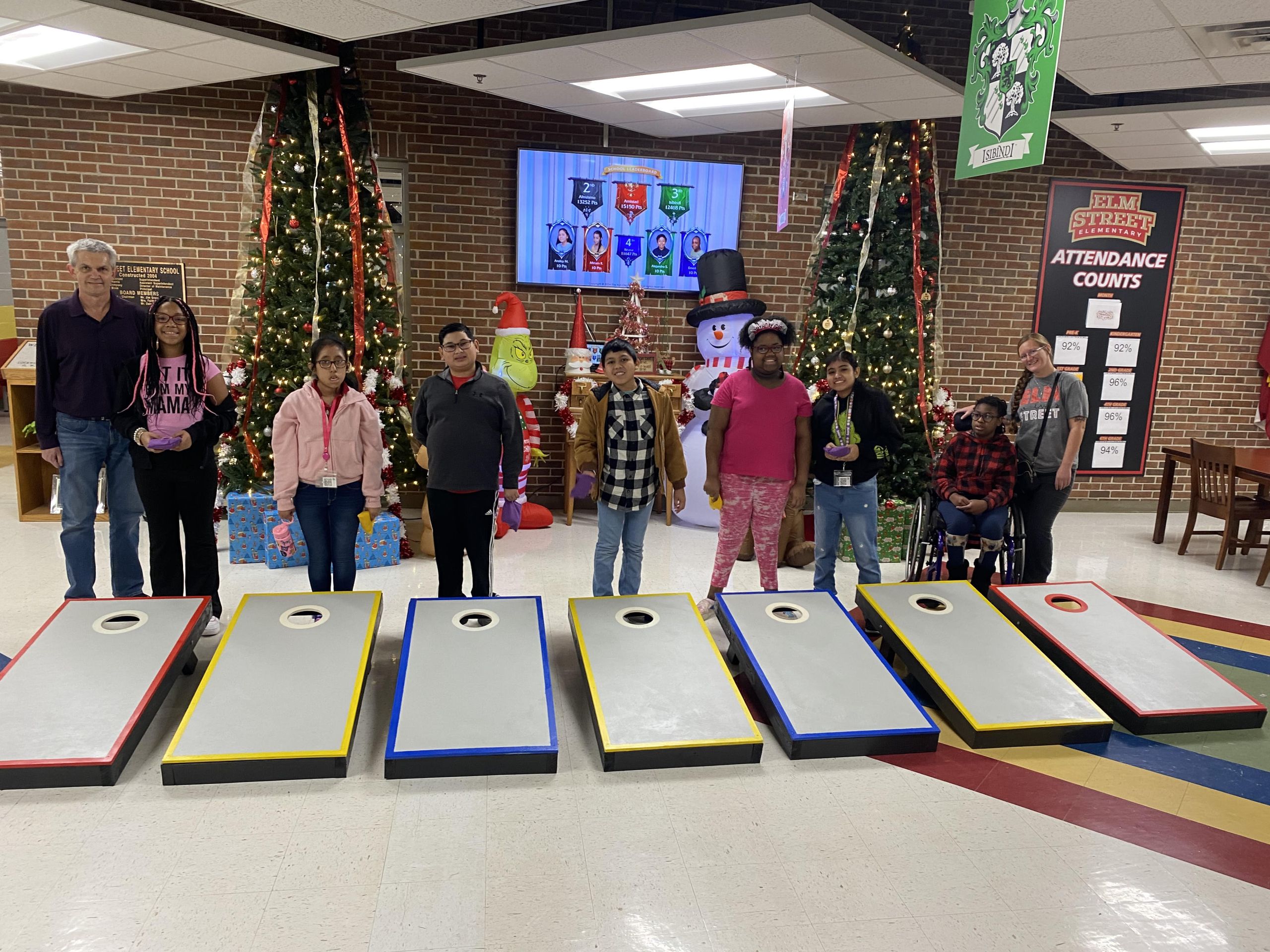

Is it a STEM Project, Life Skills Unit, a Gift, or All of the Above?
Written by: Jim Franklin
Jim Franklin, a teacher from Rome, GA, uses STEM strategies in his classroom to help prepare his students for classroom and standardized assessments, but he does not stop there. He thinks long-term and plans lessons that have a purpose and relates the academic standards to essential life skills.
At the beginning of the 2024-25 school year, Jim’s class had been reviewing addition and subtraction math fact fluency strategies. Because his students were in the 6th grade and were rapidly improving their fluency skills, Jim began to stress the importance of multiplication math fact fluency as a foundation to learn more advanced math standards.
Because Jim values feedback from his students, he showed a short video of a cornhole game on YouTube. After they watched the video, Jim asked his students if they would be interested in designing and building their own game to play with their family and friends. All of his students gave a very enthusiastic, “Yes!” Their response made Jim’s decision an easy one to proceed with the project. Over the years he has observed success due to his students having input in his instructional planning.
Jim clearly explained to his students that building cornhole games would not be finished in one day. He stated that numerous steps and procedures would need to be implemented over several weeks for educational and safety reasons. Jim also mentioned that they would still need to work on mastering their math addition, subtraction, and multiplication fact fluency skills and continue to improve their math reasoning skills by working independently and collaborating with their classmates if they required assistance. If the problem still required his assistance, he was more than willing to help them by taking a “STEM pause.
“Rather than give his students worksheets and use other traditional strategies to learn multiplication math facts, Jim planned a hands-on project that required students to incorporate all three operations which would benefit his students for years to come.”
Step 1: Planning
The class researched “Designing Regulation Cornhole Games and Materials” on their Chromebooks by dividing into two groups; Jim also recommended that they search for “kid- friendly” directions. Then, each group took turns reading the game’s materials and directions that they chose. He differentiated the reading of the materials and directions by calling on his students based on the difficulty of the text and other reading strategies. After his students compared and contrasted the two plans, they voted on the plans to build the cornhole games. After the plan was chosen, Jim also highlighted the various types of math standards involved. The importance of having strong reading fluency skills and understanding of the directions were necessary to even begin the project.
It is important to note that there are many plans available on the Internet. This is the link for the directions that were used during the project.
 How to Build Regulation Cornhole Boards
Because money to build the games was not available from his school, Jim visited a local business partner in person to obtain materials to build a cornhole game for all of his students. The business partner requested plans and goals of the project in order to make a donation of building materials. To obtain an accurate order, Jim had his students revisit the regulation dimensions of an official cornhole game that they were going to use as a result of their research. Because nine games were going to be built, the students had to multiply materials, such as screws, washers, carriage bolts, and nuts needed by nine. They also had to calculate the perimeter and area of the game by using their repeated addition or multiplication math fact fluency skills that they learned in class to determine how many gallons of paint would be needed. Then, he modeled how to shop on the business partner’s website to fill the “cart” with the necessary materials in order to get an estimate for the games. He also stressed that reading the materials correctly on the website was necessary in order to place an accurate order.
Step 2: Building
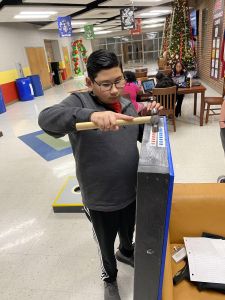
 Before one board was measured and cut or a student drilled a hole into the board, Jim shared and demonstrated the tools that would be needed and emphasized the importance of using them safely. He discussed the importance of working independently on their classwork, asking a peer for assistance, and following classroom rules while other students were working on their games.
Jim had goals for his students to improve their math skills as well as their reading and writing on a daily basis while building the project. During math class Jim dedicated the first 15 minutes of class to improving students’ math reasoning skills. The next 20 minute segment was allocated to working as independently as possible. During this time, Jim would call one student at time to the work station in the classroom. At that time, the student would complete one task with him, such as drilling holes or screwing in screws. After the student was finished, he would return to his group or work independently. Then, another student would complete the same task. During the remaining 10 minutes, Jim would summarize what the students accomplished in class and answer any academic questions from the students. The purpose of reviewing the steps in the building process was to help them understand the tasks that they completed and to increase the rate of the other games being built by the other students because they would be more familiar with the step that was going to be completed in class.
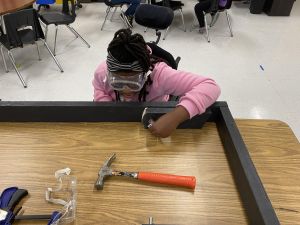 During reading class, Jim would read with his students in a small group for the first 20 minutes in class. Then, they would work independently on computer-based lessons, similar to standardized test questions, such as those found on Study Island, for 15 minutes. During this time, Jim would call one student at time to the work station in the classroom. At that time, the student would complete one task with him. After the student was finished, he would return to his group or work independently. Then, another student would complete the same task with Jim. During the remaining 10 minutes, Jim would summarize what the students accomplished in class and answer any academic questions from the students.
During writing class, Jim would review the steps that the students completed and write materials used on the dry-erase board. Then, the students would orally summarize the steps that were completed in class that day. Then, they would write a paragraph in their STEM journals. In order for the students to build the next day, they knew that they must type their paragraph to include a topic sentence and 2-4 supporting details. The details must include correct capitalization, punctuation, and grammar. The purpose of reviewing the steps in the building process was to help them understand the tasks that they completed and to increase the rate of the other games being built due to the other students being more familiar with the building process. The repetition of the instructional process in each segment provided students with continuous exposure to the directions and expectations.
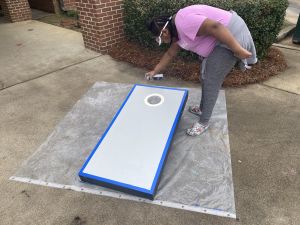
When the students were ready to paint their games, Jim recommended that the games be painted during a Friday afternoon. As a result, the paint would have enough time to dry properly, and the room could “air out” over the weekend.
It is important to note that the students measured the wood, and their measurements were checked for accuracy by Jim. Then, Jim would use a jigsaw, skil saw, and 6” hole saw to cut the wood for safety reasons. The students used the drill with close supervision, and everyone wore safety glasses. Jim also expressed how being able to measure, order materials on the Internet, and use tools are valuable life skills as well as a possible career path for those who are interested in construction.
Step 3: The Big but Easy Decision
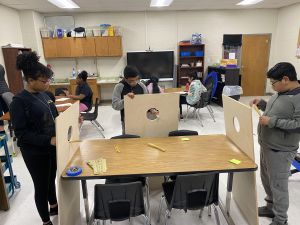 One of Jim’s students, Christian, approached him when the games were almost finished. He stated, “Mr. Franklin, I want to give my game to my family as a Christmas present.” I responded, “That is a great idea and very thoughtful of you.” Jim immediately secured all of his students’ attention. He proudly stated to them what Christian wanted to do with his game. He gave them the choice of giving the games as presents to their families or they could keep the games for themselves. Because his students were very excited about the games that they built, they unanimously agreed to give their games as presents to their families. To make their games a present, they wrapped their games and designed a Christmas card to attach to them.
On the last day of school before Christmas vacation, Jim delivered every game to all of his students’ houses. “Delivery Day” was memorable for everyone. Most of the students sprinted outside from their houses to Jim’s car to get their games as he pulled into their driveways. Some of Jim’s students had the “I can’t believe my teacher is in my living room” looks on their faces. Two students walked out of their houses with their families and gave him a hug. All of the students proudly wanted their families to open their presents in Jim’s presence.
Step 4: Showing Appreciation
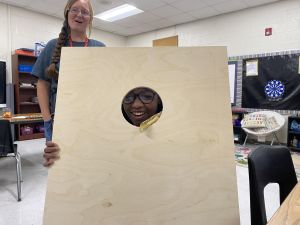 After the games were finished, Jim thanked his students for working hard, being safe, and using their reading, math, and writing skills to build a game that can last a long time. Then, he informed them that they had one more step in the project to complete. At first, the students had confused looks on their faces because their games were lined up in the classroom. Jim paused for a minute, waited for a response, and then he distributed a piece of paper and pencil to all of his students. By this time, one of his students realized what was happening. Amiya asked, “Mr. Franklin, are we going to make a thank you card?” Jim responded, “Yes. I know you appreciated the materials, but do the people who donated the materials for the games know?”
“It was a special day because there were many warm smiles on his students’ faces and even some teary-eyed parents and a teacher.”
Conclusion:
Some educators would agree that this project is a means for students to achieve academic standards, while others would view this project as a strategy for students to develop life skills. Jim believes that this is more than students building cornhole games. It was about building trust, memories, and relationships with his students and parents. By building strong parental support and bonds with students, the possibility of students grasping challenging academic standards and learning life skills rapidly increases and even greater success will more than likely follow. Do you view this cornhole game as a STEM project, life skills unit, a Christmas present, or all of the above?
Additional Information:
The project took nine weeks to complete due to the number of games being built and all of the essential standards that were identified and taught at an appropriate pace.
This project was completed by students who have a wide range of educational, physical, and construction ability levels.
A paraprofessional provided instructional assistance for the students when they worked independently or in a small group, helped maintain classroom supervision, and assisted the students with building their games. A teacher candidate also provided support during the class one day per week
Resources
Please login or register to claim PGPs.
Alternatively, you may use the PGP Request Form if you prefer to not register an account.