
Consistency in Practice
Written by: Dr. Jennifer Jensen
Center City PCS Brightwood played the long game on curriculum adoption. When the network adopted a high-quality math curriculum in 2016, school leaders assumed it would take three years for teachers to fully internalize it – and they set staff expectations accordingly. However, as students struggled to adjust to the new methods, teachers cut back on student work time and tweaked the lessons to make them easier, not yet confident that students could meet the higher bar.
Principal Westerman knew it was critical that all students were exposed to high-quality grade-level instruction. He used observations and coaching to change teachers’ mindsets and to reinforce that students were up to the challenge. He’d ask: “What are you choosing to leave in and take out? Are you taking out the right things? How can we teach it as is, with support for kids to do what the curriculum is asking?” Over time, through the consistent support and reinforcement of the instructional leader, teachers raised the bar and released more thinking to the students – resulting in an outstanding level of consistency in math.
Consistently strong instruction is grounded in grade-level content, where students demonstrate ownership in their learning. Yet, when students start school below grade level, sometimes our expectations are below grade level as well. Believing we are doing what is best for our students, we may work to bring the content “to their level,” which most often results in students remaining below grade level long term. To help students “catch up,” we have to ask the question Principal Westerman asked: “How can we teach it (grade-level content) as is, with support for kids to do what the curriculum is asking?”
In The Opportunity Makers, we learned that this is exactly what trajectory-changing schools do. They provide students with consistent access to good instruction – not unattainably perfect instruction. They consistently provide grade-level content, with appropriate support, and hold the expectation that students can do it! Trajectory-changing schools stack good days for students, and they leverage highly effective PLCs to minimize the variation between classrooms. We hope the research and the strategies shared below will support school-based teams in building consistency through rigorous content, data-driven collaboration, and regular reinforcement.
“They consistently provide grade-level content, with appropriate support, and hold the expectation that students can do it!”
Research Foundation
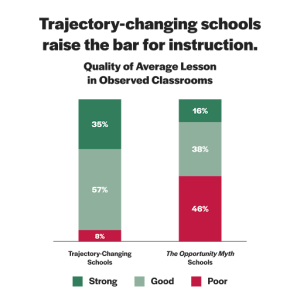 In The Opportunity Myth (2018), we found that students had the opportunity to meet grade-level standards on assignments just 17 percent of the time. Additionally, students in these schools had an almost 1 out of 2 chance of being in a classroom with instruction rated as poor. By contrast, in the seven schools studied in The Opportunity Makers, the average lesson we observed in trajectory-changing schools was rated good or strong in 9 out of 10 classrooms. Moving the average lesson from poor to good is rooted in providing grade-level content to all students, and it makes a significant difference in student outcomes. This is good news. Providing consistently good lessons is an attainable goal.
Trajectory-changing schools build consistency in three interrelated ways:
- Consistent Content: All students do the same grade-level work with different supports. Students at all learning levels work on worthy, grade-appropriate content, with support to access it if needed. Schools have an adopted curriculum in math and reading, and most teachers use it most of the time.
- Consistent Collaboration: Teachers work in structured teams to improve instruction. Professional learning communities analyze student data, identify ways to meet student needs, and apply strategies in class the next day. It’s a continuous, school-wide improvement loop.
- Consistent Reinforcement: Instructional leaders maintain a simple, shared focus. Leaders name foundational instructional practices, reinforce them with simple routines, and monitor them consistently.
Consistent Content
At trajectory-changing schools, all students consistently have access to grade-level content, with some students receiving more support to access the content. This additional support was intentionally grounded in the strengths and needs of the individual students. In one school, Eduardo, an English-language learner, received peer support and teacher prompts to finish his essay. He was held to the same bar as his classmate Sara, who needed less support.
Trajectory-changing schools ensure grade-level content and minimize variation between classes through the use of high-quality instructional materials (HQIM). All of the trajectory-changing schools in our study had adopted HQIM in math and reading. Additionally, two-thirds of teachers at these schools reported using the adopted curriculum, more than double the national average.
For schools that have adopted a quality curriculum in priority subject areas, implementation is key. As national studies have shown, successful adoption must be approached as an ongoing change effort supported by professional learning and coaching. The goal is not that all teachers apply a set of materials with strict fidelity. Rather, it is that teachers and leaders have the knowledge and capacity to apply the materials in a consistent manner that creates a more equitable learning experience for all students.
Using an evidence-based instructional observation tool, such as the Classroom Observation Protocols, is another catalyzing practice used by trajectory-changing schools. This tool can help establish a baseline for instruction and provide coaching and support aligned to growth on the rubric. A strong observation tool should include indicators that assess the learning ecosystem, high-quality content, high-quality instruction, and student ownership.
To read more about promising practices and case studies with regard to consistent content, please visit the Action Guide for Educators: Consistency.
“It is that teachers and leaders have the knowledge and capacity to apply the materials in a consistent manner that creates a more equitable learning experience for all students.”
Consistent Collaboration
Professional learning communities (PLCs) are the driving force to make grade-level learning a daily reality. While many schools do have some kind of shared, collaborative time, the use and effectiveness varies widely. Often the time can be unstructured or focus more on administrative functions, like planning for an upcoming test or field trip, rather than on instruction. In trajectory-changing schools, PLCs focus on teachers understanding the content and students engaging with their learning through academically challenging content.
Trajectory-changing schools do this by intentionally shifting practices to execute a change in the student experience. They choose a focus and use data to determine concrete action steps. For example, as Indiana has invested heavily in reading over the last two years, part of the strategy has been in supporting teachers to focus on the data from reading foundations. The five percent increase in third grade reading scores across the state is a testament to the success of this focus.
You can find additional resources for planning effective PLCs and using data to guide instruction in the Action Guide for Educators: Consistency.
Consistent Reinforcement

Once rigorous content and effective collaboration are in place, schools uphold baseline expectations in all classrooms. As one trajectory-changing school leader put it, “You can’t expect what you don’t inspect.” One way this can be accomplished is through explicitly naming foundational expectations for what should happen in class. These foundational expectations, aligned to a strong vision for the student experience, don’t have to be prescriptive. Rather, it can outline baseline expectations to help orient new staff members and lets all teachers know what to expect from observations and coaching. For example, one school created a School Improvement Playbook that outlined expectations for curriculum use and shared instructional strategies.
You can read more stories on the practices schools used to build consistency that leads to trajectory-changing experiences for students in our full research paper, The Opportunity Makers.
The Bigger Picture
The 1,300 schools we studied in The Opportunity Makers prove that US public schools can change the academic trajectories of millions of young people who’ve fallen behind. We’re so excited to share the promising practices these schools lean into every day, to support more educators in building the systems and environments our students all need to thrive. We’re especially excited to hear your questions and stories from the field, so please take 3 minutes or less to share your thoughts in our survey here.
Footnote:
Kaufman, J.H., Doan, S., Prado Tuma, A., Woo, A., Henry, D., & Lawrence, R.A. (2020). How Instructional Materials are Used and Supported in U.S. K-12 Classrooms: Findings from the 2019 American Instructional Resources Survey. Creative Commons Attribution 4.0 International Public License. https://www.rand.org/pubs/research_reports/RRA134-1.html
Resources
Please login or register to claim PGPs.
Alternatively, you may use the PGP Request Form if you prefer to not register an account.