
Redefining Success: Differentiation Without Dilution
Written by: Ashley Johnson
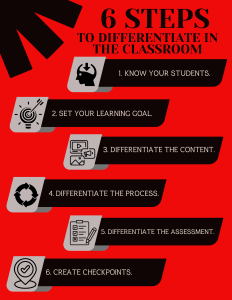
When given the task of differentiating a lesson for students, most teachers initially think this means lowering the academic rigor. In fact, the differentiation process can not only create challenging, real-world learning, but also experiences students will remember for years to come. Not all lessons are one size fits all, and it’s important to fit your teaching with your students. Follow these steps to differentiate your lessons while still providing strong learning experiences for your students.
1 – Know Your Students
Have you ever had that lesson that worked so well, you use it again the next year only to have it fall flat? Not everything you do is going to work well for every student or every class. This is why it is important to get to know your students and adjust your lessons and assignments to their needs. You will have some classes where group work will provide the best results. Other classes students do better working alone. Some classes thrive with hand-on, while others like visual examples, and yet another wants to read the steps to understand. This is why it is important to get to know your students and understand how they learn best.
At my school, we have every student take the Clifton Strengths test. Students then know their top five strengths and continue to do work with that information throughout high school. Being able to have this information about your students is extremely valuable in understanding the way they operate. In my Entrepreneurship classes, students take the BP10 test (another Clifton test), and they are classified into one of three categories of entrepreneurs. We do a lot of work using this information and how it best suits them when running their businesses.
While these are great resources to use when getting to know your students, you don’t have a fancy test to get to know your students. There are online assessments that can determine what type of learner a student is. Use your observations to see who likes to lead in group settings and who likes to be given a task. This is all great information when it comes to planning and building your classroom and lesson structure.
2 – Set Your Learning Goals
This is probably the most important step. You need to figure out WHAT your learning goals are. What do you want your students to master? Sometimes teachers get stuck on the HOW of student learning first. Some think, we have always read this book and answered these questions or taken these notes and completed this test. But, we need to figure out the WHAT before the HOW. Once you have determined what you want your students to know, you will figure out the how in the next few steps.
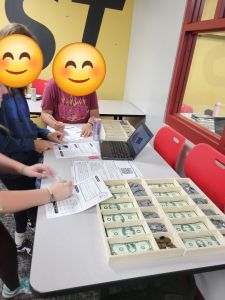
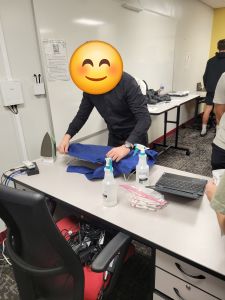
A few years ago, I determined that I wanted students to learn some tasks that were once considered everyday tasks, but students have struggled with in recent years. I wanted students to know how to make a professional phone call, how to handwrite a thank you note, and how to iron a shirt. I eventually came up with ten tasks that I wanted them to know how to do. I had the WHAT, now to create an impressionable HOW. See what I came up with here!
“We need to figure out the WHAT before the HOW.”
3 – Differentiate The Content
We all know, not all students learn the same way. Finding different ways to deliver the content, giving students choice in how they learn can be difficult, but makes all the difference in the world. Provide students with multiple resources for learning the content, not just the textbook. This could look a number of ways. Of course, you have your tried and true lectures, PowerPoints, and review games. You can also add relevant articles and podcasts, short videos, simulations, hands-on experiences, peer reviews, guest speakers, field trips, etc. Try to have three different ways for content to be presented to give them the best chance at mastering the knowledge goal.
With my ten tasks defining the WHAT I wanted my students to learn, I now needed the HOW. I knew that standing in front of the class and talking about these tasks and telling them the proper way to do them wasn’t going to work with my students. For each of the ten tasks, I created three types of content for students to interact with to learn the task. First, I recorded video examples of how to complete each task, then I created written instructions on how to complete each task, and third, I created a hand-on lab for each station. By using one or more of these methods, students could choose how they learned each task.
4 – Differentiate The Process
Varying the process of delivering your content can get difficult and time-consuming, but it is necessary. How many times have you sat in a PD session where someone just read off the slides to you? Did you like it? Neither do the kids. Finding different ways to deliver the content of your knowledge goals freshens things up and keeps the students excited to see what is next. Some different delivery methods could be: choice boards, learning stations, independent research, group activities, hands-on application, etc.
I decided to turn my ten knowledge goals with their three forms of delivery into stations. Around the room each station was set up with access to the video, a poster of written directions, and the hands-on lab for students to practice. Instead of a normal sit at your desk and watch the teacher kind of day, students were able to get up and move. They could choose which station they wanted to visit first, they could revisit a station, they could help a classmate if they were having trouble at a station. Students really enjoyed the day because this learning process was different to what they have experienced in the past.
5 – Differentiate The Assessment
What is the final product students are turning in? How are you assessing if they have mastered the learning goal? Is it always some sort of test? Remember, some students are bad test takers. By differentiating the final assessment students are using to demonstrate they mastered the knowledge goal, you allow students to use their strengths and talents to show you what they have learned. Plus, in this day of Artificial Intelligence, assigning a test or paper may not really be assessing the student’s knowledge. Make the assessment more personalized, giving the student no choice but to do it themself. Assessments could be: podcasts, presentations, creating a museum exhibit, a short play or skit, infographics, building a model, creating a poem or song, etc.
For the “How To Stations,” students personally demonstrated each task to show their mastery of the knowledge goal. In my Personal Finance class, students have written and illustrated children’s books on specific personal finance topics (learn more about that project here!). When my Entrepreneurship students finish a book study, they have created a new book jacket for the book and included reviews for the back cover.
“The word differentiation doesn’t mean ‘make it easier,’ it means ‘make it effective.’”
6 – Create Checkpoints
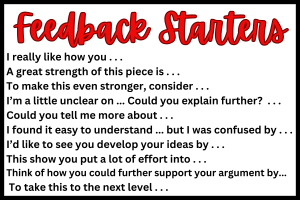
It is important to create regular checkpoints to make sure students are understanding what they are doing and on pace to turn in a final product. There is nothing worse than getting to the end of a three-week project and having a student turn in something way off track from what you were expecting or, worse yet, nothing at all. These checkpoints can come in many forms: regular one-on-one meetings, progress reports, or exit tickets. Make sure you are giving detailed feedback to point students in the right direction. See the “Feedback Starters Card” for help when providing student feedback. If you use your checkpoint tools correctly, you should not be caught off guard by the end product of a student.
For students doing the “How to Stations,” they had a checkpoint after each station. They did not move on to the next until they had mastered their current task.
The word differentiation doesn’t mean “make it easier,” it means “make it effective.” Students who can display their knowledge in a variety of ways are more likely to retain that information. Plus, differentiation can make learning more fun, not only for the students, but for you as the teacher. Would you rather read 30 book reports or listen to student-created podcasts on their reflection and takeaways of the book?
Missed part 1 of the series? Check it out!
Resources
Please login or register to claim PGPs.
Alternatively, you may use the PGP Request Form if you prefer to not register an account.