
What is the Science of Reading?
Written by: Erin McNeill
As part of my transition from teaching preservice English education teachers to a Professional Learning Specialist at Keep Indiana Learning, I have spent the last several months immersed in the research and opinions surrounding the Science of Reading. There are many great resources to share, and I have also developed a six-part webinar series that covers the research-based tenets of the Science of Reading and offers resources for implementing these ideas in classrooms. My takeaway from studying this topic is that it is an exciting time to be a literacy educator as we explore ways to help all children read well. So, what is the science of reading, and why is the science of reading important?
What is the Science of Reading?
A definition of the Science of Reading, courtesy of Petscher et al.(2020), describes, “The ‘science of reading’ as a phrase representing the accumulated knowledge about reading, reading development, and best practices for reading instruction obtained by the use of the scientific method” (p. 268). In the 1980s and 1990s, researchers and practitioners debated how best to teach reading. You may have heard this referred to as The Reading Wars. In 2000, Congress asked the National Reading Panel to review all available reading research, around 100,000 studies. The National Reading Panel’s analysis made it clear that the best approach to reading instruction is one that incorporates the following:
- Explicit instruction in phonemic awareness
- Systematic phonics instruction
- Methods to improve fluency
- Ways to enhance comprehension
Many media reports about the science of reading focus on phonemic and phonics instruction. Yet, Alexander (2020) argues, “the reality is that reading does not begin or end with phonics or whole-word instruction (Seidenberg, 2013). It is far broader and more complex” (p. 89). The Science of Reading is a vast body of knowledge with many interpretations. Still, five research-based ideas have found their way to classrooms: phonemic awareness, phonics, vocabulary instruction, fluency, and comprehension. These five ideas comprise the Science of Reading; they work together and build on one another.
Classroom Application
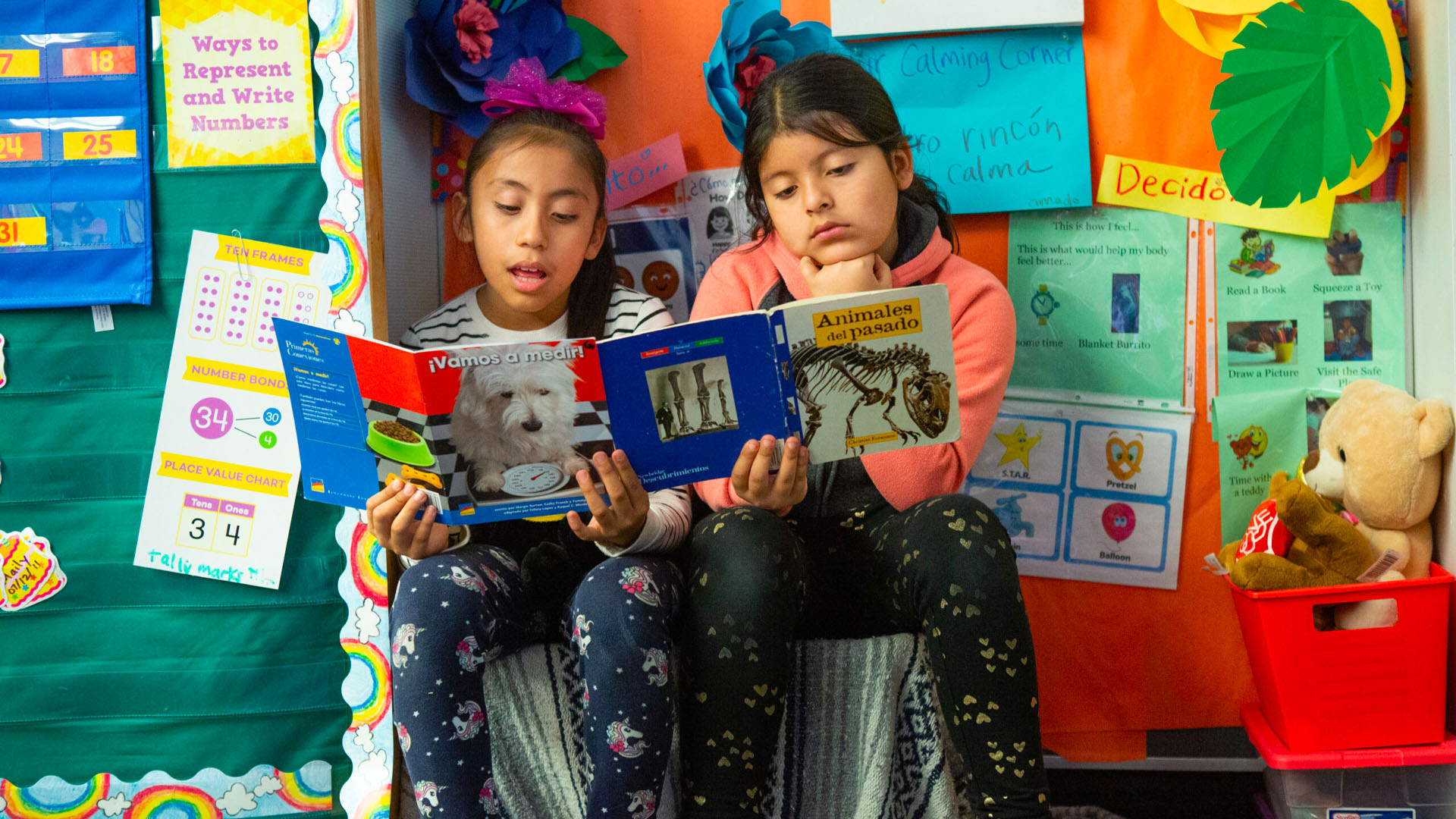
In an early literacy classroom setting, this instruction is explicit and intentional. For example, a teacher teaching phoneme-grapheme mapping (teaching students to connect the sounds/phonemes in words to letters/graphemes) would spend a few days teaching students that/ai/ is a grapheme that represents the single sound of long a. Students would hear, say, and write the sound. They would practice saying words that contain that sound, such as rain or main, and learn their meanings using visuals and modeling. Additionally, any books read in that unit would contain decodable words using the long a sound, which the teacher can model and pronounce. Read-alouds would also contain similar words, and teachers would model fluent reading and comprehension strategies they use to make sense of the text. Our Using Interactive Read-Alouds to Their Fullest Potential blog shares strategies for choosing read-aloud texts and ideas for modeling comprehension strategies. Read-alouds can be an effective way to model clarifying meaning, asking and answering questions, and making inferences.
Why is the Science of Reading Important?
In simple terms, the science of reading is a vast, evolving body of knowledge that draws on research spanning several decades. It advocates instruction in decoding and word skills, generative vocabulary skills and application, fluency-building activities, and comprehension strategies that ask students to slow down and think deeply about texts. It is not a specific curriculum or a one-size-fits-all approach to reading instruction. The science of reading instruction does not ask students to use visual cues to guess a word. Instead, educators teach students to decode words using phoneme-grapheme mapping, and students can then apply these skills to new words they encounter.
It is important to understand that these skills are necessary for reading instruction. Still, it is also important for educators to understand what happens in the brain when someone learns to read. “Reading isn’t a natural brain activity — it’s a learned one” (Reading Changes a Child’s Brain: Here’s how). Our brains understand speech sounds by design, but we have to learn to convert letters into speech sounds. A leader in this field is Dr. Sanislas Dehaene, a cognitive neuroscientist who used MRI machines to study children’s brains as they learned to read. His book, Reading in the Brain: The New Science of How We Read, details his and historical research on how humans process language. Dr. Dehaene explains, “Advances in psychology and neuroscience over the last twenty years have begun to unravel the principles underlying the brain’s reading circuits. Modern brain imaging methods now reveal, in just a matter of minutes, the brain areas that activate when we decipher written words” (Dehaene, 2009, p.1). His research shows we first process the written word with our eyes. Historical research on reading by Edmond Huey, who developed eye-tracking software, helped scientists realize that our eyes track every letter in a word, which means it is important for readers to decompose a word into its phonemes and, eventually, morphemes. Dr. Dehaene’s research reveals that after words are visually processed, they are reported to our brain’s letterbox. “It (the letterbox) then transmits this information to two major sets of brain areas…that respectively encode sound pattern and meaning” (Dehaene, 2009, p. 53). The two paths are:
- “Infrequently used words and neologisms move along a phonological route that converts letter strings into speech sounds.”
- Called an orthographic filter
- “Frequently used words…are recognized via a mental lexicon that allows us to access their identity and meaning” (Dehaene, 2009, p. 104).
- Called a semantic filter
Therefore, readers must know how to decode words using speech sounds. After we have decoded a word several times, a process called orthographic mapping, we learn these words as sight words.

Neuroimaging research shows that we break words down into sounds first, so phonemic and phonological awareness are especially important in early elementary classrooms. The video “What Teachers Should Know About the Science of Reading” explains this phenomenon well; Emily Hanford breaks down these steps, starting with how our brains recognize all letters, and eventually all sounds, in a word. Students understand the spoken word but must incorporate the visual word into their memory. They do this by processing the sounds in a word several times, with the goal of processing sounds (through both phonemic awareness and phonics) to achieve whole-word recognition. For more information about the five phases of cognitive processes that occur in beginning readers as they transition from basic visual recognition to fluent readers, check out the KINL blog on Ehri’s Phases of Reading Development Part 1 and Part 2. Ehri’s research describes how word-reading skills develop in children.
This research matters to teachers for several reasons. First, educators can sound out difficult or new words and model that for students. We can teach students how to orthographically map a word. Also, educators can teach students to connect new words to words they already know when reading new texts. Modeling these connections can help activate students’ background knowledge. Using visuals alongside new words also activates background knowledge of the words. Educators can also use semantic maps to help students brainstorm words they know related to new vocabulary or concepts.
Science of Reading Curriculum and Instruction
As a result of this research, reading instructors are shifting from whole-word, whole-language, and cueing instruction to explicit, systematic phoneme and phonics instruction. By teaching students to decode words, they can use these skills to decode and learn new words they encounter. You can read more about the shifts teachers are making toward a science of reading instruction approach in our blogs detailing Burkins and Yates’ book, The Six Shifts: Embracing Balanced Literacy and the Science of Reading Part One. This blog examines shifts in the importance of oral language, phonemic awareness, and phonics in the development of reading skills. Part 2 of this blog details shifts in instruction for beginning readers to focus on phonemes and how they are represented in high-priority words, use decoding strategies for word-solving and understanding meaning, and reconsider decodable texts for beginning readers.
As educators, we must understand how children learn to be good readers, but we must also consider student engagement and the artful teaching of reading. In my Integrating the Science of Reading into Literacy Lessons blog post, I reviewed the five tenets of the science of reading and provided resources from researchers and teachers who effectively apply it in their classrooms. There is also a similar webinar series for more information on integrating each of these tenets into our current curriculum.
The five research-based ideas of phonemic awareness, phonics, vocabulary instruction, fluency, and comprehension also have practical applications in the classroom and on a student’s ability to read texts. Phonemic awareness and phonics are building word knowledge and skills that students will use as they encounter new words. The brain research previously reviewed by Dehaene explains that the brain uses orthographic mapping to convert letters into speech sounds; this process starts with phonemic awareness and phonics instruction.
Likewise, fluency and vocabulary instruction are imperative for building vocabulary and bridging the gap between decoding and comprehension. Preteaching vocabulary is essential to understanding complex texts. If a student is unsure of a word’s meaning, they may misinterpret or skip a passage, leading to a breakdown in meaning. By teaching word parts, or morphology, we can develop generative vocabulary skills, allowing students to determine the meanings of new words by identifying word parts and their relationships to other words. When we consider fluency instruction as the act of rereading to build automatic word recognition and improve expression and accuracy, with the goal of increasing comprehension, students will slow down and consider new words, meanings, or understandings as they read. Incorporating fluency-building activities and vocabulary can increase comprehension by allowing students to spend less time on decoding and focus on a text’s meaning. Finally, comprehension strategies are useful because they ask students to slow down and think deeply about what they are reading. It is imperative that teachers model the use of all of these strategies during read-alouds.
Additionally, two stellar book resources for integrating the science of reading with adolescent students are When Kids Can’t Read – What Teachers Can Do and Teaching Foundational Skills to Adolescent Readers. These resources are impressive guides with activities that ensure the science of reading instruction is followed when reading texts with students. Fisher and Frey (et al., p. 150, 2025) remind teachers to integrate reading skills, such as building students’ decoding skills at all levels, provide fluency-building activities, use comprehension strategies, in all texts, as well as to provide students with challenging texts.
Classroom Application
In an adolescent literacy classroom, this practice would look like preteaching difficult vocabulary before reading a text. Educators could model the pronunciation of new vocabulary, explicitly explain its meaning, and ask students to make connections to other words with similar word parts or meanings. Also, difficult sections of the text could be reread in small groups as students practice difficult words and clarify meaning, in an effort to make reading the passage automatic. Comprehension strategies can also be modeled and applied to challenging texts to help students slow down and think deeply about what they are reading. It is important to remember that adolescent reading follows the same science of reading theories, but the applications differ.
“The five research-based ideas of phonemic awareness, phonics, vocabulary instruction, fluency, and comprehension also have practical applications in the classroom and on a student’s ability to read texts.”
Where Can I Receive Science of Reading Professional Development?
Keep Indiana Learning has two dedicated literacy professional development specialists who have extensively studied the integration of the science of reading into practice and into existing curriculum. Our professional development sessions focus on meeting educators where they are and integrating the science of reading research into their existing curricula and practice. Additionally, we have a dedicated team of Literacy Training Support Specialists who are actively coaching school staff on integrating these tenets into their science of reading curriculum and instruction. Our team would be happy to collaborate with you and your school to customize science of reading professional development for all grade levels that meets your needs and level of expertise.
Resources
Please login or register to claim PGPs.
Alternatively, you may use the PGP Request Form if you prefer to not register an account.